Showing posts with label Beaufort County NC. Show all posts

Friday, December 28, 2012

The Mystery of Samuel Windley, alias Samuel Keach: Analysis of Document #19

In the spirit of discovering who each of these men were who had shared bits of Sergeant Isaac Carter's life, and who had come forth to testify on his behalf for a Civil War Pension, I began my search for Samuel Keach with a search on Ancestry.com and on Fold3.

Surprisingly, only two documents surfaced:
  1. (4) U.S. Civil War Pension Index: General Index to Pension Files: 1861-1934, and
  2. (1) U.S. Colored Troops Military Service Records, 1861-1865.


Search Results Provided By Ancestry.com

Data Source: U.S., Civil War Pension Index: General Index to Pension Files, 1861-1934
Tue Dec 25 2012 16:53:22 GMT-0500 (Eastern Standard Time)

View RecordNameWidowState Filed
View RecordSamuel Keach Louisa KeachNorth Carolina
View RecordSamuel Windley
[Samuel Keach] 
Luvenine ReachNorth Carolina
View RecordSamuel Windley
[Samuel Keach] 
Louisa KeachNorth Carolina
View RecordSamuel Windley
[Samuel Keach] 
North Carolina

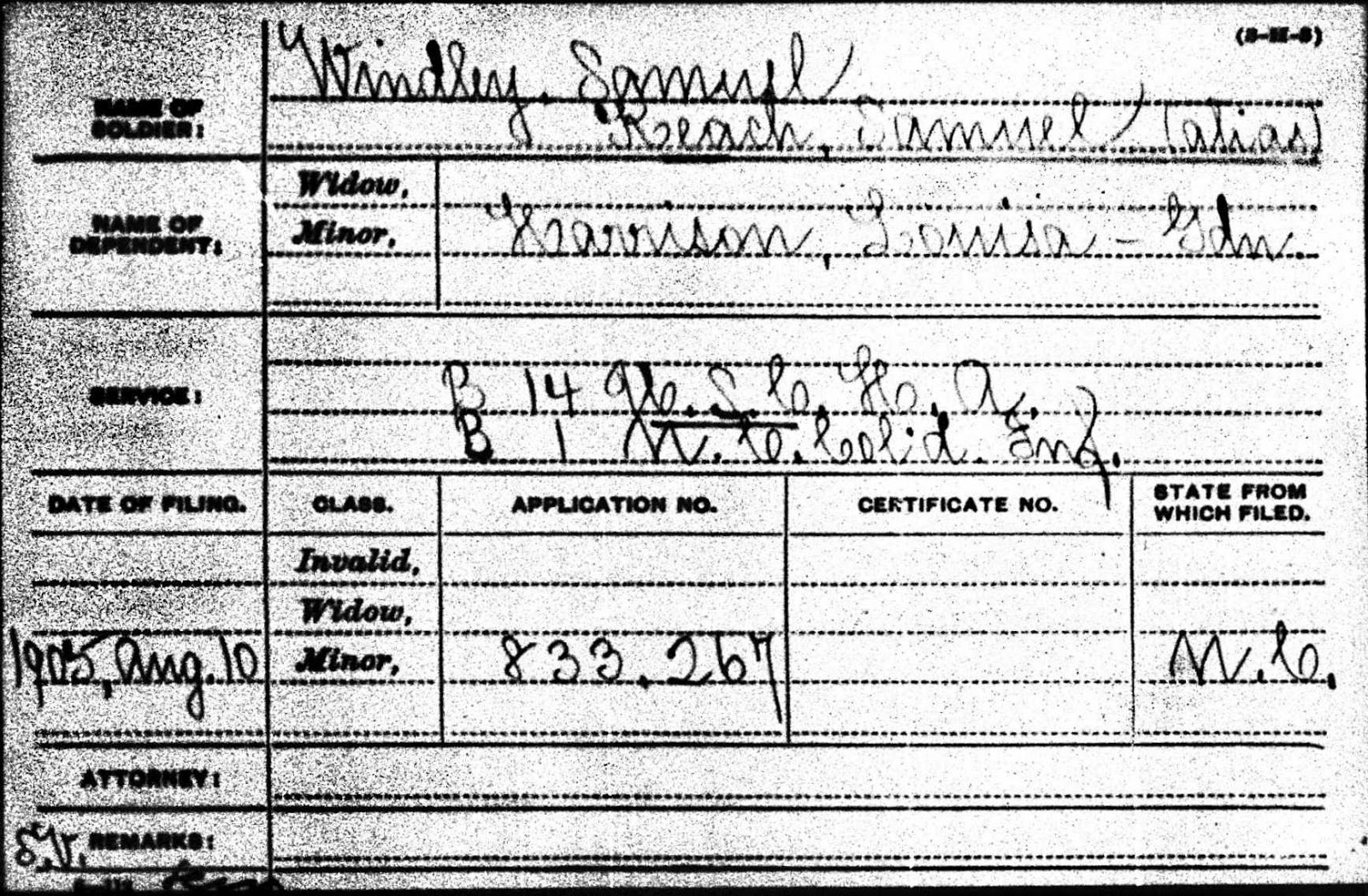
Looking at the screenshot of my Ancestry.com search #1, I wondered about this surname, Windley. Often you will find a transcription error in indexing, or perhaps even an enumeration error where the name was spelled phonetically, based on the informant's accent or regional dialect. However, there's a large difference between Keach and Windley. The widow's name, Luvenine Reach, is identified immediately as a transcription error. Her name should read: Luvennie Keach. But in two documents listed, the widow's surname is recorded as Louisa Keach. The question is now whether this is a reporting/recording error, or if there are two widows.

Image No. 1
Image No. 1, however, notes that Samuel Keach was an alias. With that said, I began looking for Windley information (more to come). 

Let's take a look at the information provided on this application card:
  • There are three other persons reported here: 1.) the widow: Louisa Keach; 2.) a minor: Louisa Harrison, Gdn; and, 3.) the contesting widow: Luvennie Keach. 
  • Two types of service were recorded: Co. B, 1st Regiment North Carolina Colored Infantry, and Co. B, 14th Regiment US Colored Heavy Artillery. 
  • The dates of filing show that:
  1.  the Invalid (Samuel Keach) filed on Feb. 11, 1888: Application No. 639.673, Certificate No. 749.574;
  2.  the widow on March 19, 1898: Application No. 673.017;
  3.  the minor on Aug. 10, 1905, Application No. 833.267; and,
  4.  the contesting widow on July 5, 1900, Application No. 743.387. 
Image No. 2

If I were to apply for Samuel Keach's Civil War Pension File from NARA, I would need all of the above information in order to request his complete file.
Image No. 4
Image No. 3
Images 2-4 are the individual applications of the widow, minor and contesting widow.


In search of the Windley surname
My first step was to check the Public Member Trees: <Samuel Windley, USA, North Carolina.> At the time of his affidavit he was 45 years old, making him born abt. 1846. He had enlisted in Washington, NC, so I'll be searching for people living in Beaufort County. I discovered a tree entitled, Windley Family Tree, with an individual named, Samuel S. Windley, b. 7 June 1848; d. 1911.

I always look for a documented tree, but note that this has no documentation on this individual. So, I search for some Census records for this Samuel S. Windley, son of Samuel and Angelica (Jones) Windley.

In 1850 he was living in Broad Creek, Beaufort, NC. This family is composed of the parents and five children. One small problem. The family is white, and there are no black families listed. So, I check out the 1850 Slave Schedules to see if Samuel & Ann Windley owned any slaves.

Sure enough, they owned three slaves: a black female (23), a black male (20), and a black male (4). The child would have been born abt. 1846, the same age as Samuel Keach Windley. I located an obituary for him at New-Bern Craven County Public Library posted in the New Bern Daily Journal, 30 October 1896. I am hopeful to discover some other information about him from the obituary, but must wait till I receive it to know for sure.

Another document I located naming this Samuel Keach Windley was the death certificate of his second wife, Louvina Eborn. It states that she was the daughter of Frank Blount and Jennie Eborn, both of Roanoke Island, NC. She died on October 28, 1922 at the age of 100. She had been divorced from her husband, Samuel Windley.

Samuel Keach Windley survived five years, seven months and twelve days beyond his testimony. Beyond his obituary, the only other hope of gaining any information about this man would be from his Civil War Pension File. Perhaps one day we'll have more to report, but until then...


Thursday, September 20, 2012

The Old Newbern Courthouse


One of the biggest frustrations for me as a researcher/writer is coming to a screeching halt at the appearance of a giant pothole in the middle of the road. It's not quite the same as coming to a dead end. There's more information to fill in the path...somewhere...but where...and when? 

Just as I was really getting somewhere with character development, I received an email which opened up a whole new avenue of exploration in regards to the old Newbern Courthouse.

New Bern, Newbern or New Berne?
Allow me to begin with just a brief note on historic spellings for our city. Victor T. Jones Jr., the Special Collections Librarian in the Kellenberger Room at New Bern-Craven County Public Library, says in a recent Facebook communication:
Officially they started writing New Bern as two words in the 1890s. Before the Civil War, it was mostly written as one word (Newbern), though there are some examples of it as two. During the Civil War occupation is when the "e" was added to Bern (New Berne). In the late 1890s and early 1900s there was a big debate in town about whether it was one word or two, with the e or without. It was finally settled with the the way it is currently spelled, two words without the e.
Since the time period I am focusing on is the 1850s, I will be using the antebellum spelling, Newbern.

Back to the Courthouse...
In our story, the old Newbern Couthouse is the focal point of our first scene, where the four youngest Carter children appear to be bound out as apprentices to the household of William Temple.

I have studied historical accounts and maps of the city, but not till I received copies of the following photos...all that remains of the memory of the old Newbern Courthouse...did I begin to recreate the scene from the children's point of view (POV). I had actually received the photos back in mid-May; but, a more recent email provided the stimulus to try to identify the style of the court house beyond the ruins below:

Ruins of the Craven County Court House,
destroyed by fire January 15, 1861.
The Court House stood in the intersection
of Broad and Middle streets. This view
was taken from Broad Street looking west.
The old Market House is visible
beyond the ruins.
The photos answered a question I had earlier based on a the map I had previously view which placed the court house in the intersection of Broad and Middle Streets.

In the intersection, as opposed to at the intersection, was the correct phrasing; although, it was highly unimaginable for me. How could a court house be placed in an intersection, especially one lined with trees which would have made the roadway about it quite narrow?

From these photos we can see all that remained was the corner of the building.
Ruins of the Craven County Court House.
View taken on Middle Street looking north.
A New Bern Album, by John B. Green, III
(1985), p. 26.

It appears to have been a three story structure, with perhaps three sets of windows on each floor.

This was the second court house in Newbern. The original one was to be built in 1761 by orders of Richard Spaight, Esq., Joseph Leech and John Fonville, Commissioners. It was ordered "that a Court House for the said county [Craven], not exceeding sixty feet long and forty feet wide in the clear be build on the public lots in the town of Newbern ...on the intersection of Broad street where a Court house is already begun" (Rambles about Town: Pollock Street from Queen to Middle, October 8, 1882).

John D. Whitford also noted that "This old court house gave place to the brick one build on the same site about forty years afterwards, which was destroyed by fire just before the war. We have a photograph (above) of the walls with the houses then around them, taken immediately after the fire."

Of the second court house, Mr. Whitford states:
The clock on the cupola of the court house belonged to the town, was purchased in 1826, and no better was ever made and set up. The bell was the property of the county, and not only gave us the hours through the day and night, but it was also rung for all fire company meetings, political meetings, or any kind of town or county meetings, as well as give the alarm of fires.

While Victor had encouraged me to check the colonial architecture of the existing Chowan and Beaufort County court houses, I am now convinced that while the original courthouse may have had some of these colonial influences, this second courthouse did not. And this is how I came upon this conclusion:

Below you will find a collage I constructed of all the photos available on a Google Image search for the Old Chowan County Courthouse in Edenton, NC:

I was so excited about the detail I had discovered, especially the interior design.

The old Beaufort County Courthouse in Washington, North Carolina can be seen below:


While they both have a copula with a clock and bell, I decided to look for images of three-story southern courthouses built around the turn of the 19th century.

Jones County Courthouse, Trenton, NC
I am now somewhat convinced that the second Newbern Courthouse may have looked more like this courthouse built in nearby Jones County, North Carolina.

Whitford states that the original...
Court house is raised on brick arches so as to render the lower part a convenient market place, but the principal (sic) marketing is done with the people in their canoes and boats at the river side.
If the arches were carried over into the design of the second courthouse, perhaps it might look somewhat like the front of the U. S. Post Office and Courthouse in New Bern, seen below:
by eopederson45
Old Fairfax County Courthouse in Fairfax City, Virginia was built in 1799, close to the time the second Newbern Courthouse was erected. Notice the similarity in the use of brick arches in its design.

Courtroom Design
There are some similarities in courtroom design between Fairfax County Courthouse and those of Chowan County, North Carolina,  and James City (colonial Williamsburg) and Isle of Wight Counties in Virginia, which share the same layout.
Ultimately, what I will have to do is to use my imagination to combine elements of all of these settings to re-create the exterior and interior of the second Old Newbern Courthouse for this scene.


And now you can see how the giant pothole in the middle of the road got filled in with a little help from my friends.


Private Martin Black: Revolutionary War Pension File (S41441), Part 2

In March, I shared the transcription of  Private Martin Black's Revolutionary War Pension File , in which he described his service in mo...