Showing posts with label TEMPLE. Show all posts

Sunday, August 4, 2013

The Estate File of Isaac Dove (1826), Part 2: The Land Division and Index

Last time we looked at this particular file, we were looking for relationship connections.  Petition made by "George Carter & others" provided us with the names of Isaac Dove's (FPOC) children and their spouses:

  1. George Carter and his wife, Susannah/Susan/Sukey (Dove),
  2. Gambo Fenner and his wife, Deborah/Debby (Dove),
  3. Stephen Gaudett/Godette and his wife, Mary (Dove),
  4. William Dove and his wife Rebecca (Godette),
  5. Jacob Dove.
On this occasion, we'll be looking at the land division for two tracts of land: the first being on Cahooque Creek, the second along Clubfoot Creek. To complicate matters, the petitions and court records do not appear to be assembled within the file in chronological order. So, the first task will be to put the images into order by date.

"North Carolina, Estate Files, 1663-1979,"
index and images, 
FamilySearch
(https://familysearch.org/pal:/MM9.1.1/VKJM-FYZ :
accessed 05 Aug 2013), Isaac Dove, 1826.
Index of documents as found within the file:
Images 2-4/45: Partition of the Land of Dove & Brown/Plat & Description/4 February 1826

Image 5/45: Summons: Hardy L. Jones, James T. Jones Esqr., Gideon Jones, Joseph Davis & Benjamin Borden/RE: Lands on east side Spring Branch/14 November 1825

Image 6/45: George Carter &. Al.--heirs of Isaac Dove vs. A. Brown, Jacob Dove, Will. Dove/Writ of Petition/February 1826

Images 7-10/45: Division of Lands (by Consent) vs. Isaac Dove/Plat, Folio 47/March 1826

Image 11/45: Receipt from Isaac Doves' Heirs to Hardy Jones for Survey & Plat/4 February 1826

Image 12/45: Summons: Anthony Brown, William Dove & Jacob Dove/9 August 1824

Image 13/45: George Carter &. al. vs. Will. Dove & others/Subpena to return/November 1824

Image 14/45: Appointment of Commissioners to divide land/undated

Image 15/45: Summons: Hardy L. Jones, James T. Jones Esq., Gideon Jones, Joseph Davis and Benjamin Borden/8 Aug 1825

Image 16/45: George Carter & wife & other heirs of Isaac Dove/Writ of Petition/November 1825/RE: Summoned to Meet 28 October 1825/Rec'd Sept. 12th

Image 17/45: Summons: Hardy L. Jones, James T. Jones Esq., Gideon Jones, Joseph Davis and Benjamin Borden/9 May 1825

Image 18/45: Geo. Carter & wife & others, heirs of Isaac Dove/Writ of Petition/August 1825/The parties summoned but did not act/Rec'd June 19 [1825]

Image 19/45: Receipt: William Physioc charges A. Brown/17 February 1825

Image 20/45: To the Sheriff: Command to summon William Physioc & Isaac Lewis personally...in behalf of Anthony Brown/trial date 14 February 1825/8 November 1824

Image 21/45: Geo. Carter & wife vs. Anthony Brown & al./February 1825

Image 22/45: Summons: Hardy L. Jones, John Allways, William Physioc, Joseph Physioc Esquire & Clairborne Ivey Esquire/8 November 1824

Image 23/45: George Lewis by his next friend vs. Heirs of John Godett/Writ of Petition/May Term 1824/The Surveyor could not possibly attend to make partition before this term

Image 24-26/45: Summons: William Dove/9 August 1824/Writ of Petition attached: George Carter & wife, & al.

Images 27-28/45: Answer from the Defendant/11 November 1824

Images 29-30/45: Writ of Petition: George Carter & wife, Stephen Gaudet & wife, Gambo Fenner & wife vs. Anthony Brown, Jacob Dove & William Dove/August 1824

Images 31-33/45: Summons: Jacob Dove/9 August 1824/Writ of Petition attached: George Carter & al./Made know by reading the within to Jacob Dove

Image 34/45: Summons: Thomas J. Physioc, Benjamin F. Borden, William Temple, David Dickerson, and Jeremiah Parsons/8 December 1851

Image 35/45: Henry J. Lovick, Deborah Fenner, Stephen Gaudet & wife, George Carter & wife/Writ of Petition/8 March 1852

Image 36/45: Court fees assessed: $20.90/21 May 1857

Image 37/45: Office vs. Henry J. Lovick 1/4, Debra Fenner 1/4, Stephen Gaudet & wife 1/4, {Arnett Dove, Geo. Carter & Wm. Carter 1/4}/June 1857

Image 38/45: Summons: Thomas J. Physioc, Benjamin F. Borden, William Temple, David Dickerson, & Jeremiah Parsons/8 March 1852

Image 39/45: Henry J. Lovick, Deborah Fenner & others/Writ of Petition/June 1852

Image 40/45: Summons: Thomas J. Physioc, Benjamin F. Borden, William Temple, David Dickerson and Jeremiah Parsons/8 September 1851

Image 41-44/45: Henry J. Lovick, George Carter, Stephen Gaudet, & others/Writ of Petition/December 1851

Image 45/45: Henry J. Lovick & others to Court/Petition for Partition/Filed September Term 1853/[8] June Term 1857

Conclusions & next step:
It would seem to me that if I were to order the above documents to chronological order, I might be able to make more sense of the progress of this land partition dispute. One note of interest, by Image 37/45 dated March 1852, Deborah Fenner's husband, Gambo, is no longer named with her, leading me to believe that he died before this dispute was ever finalized. 

Overall, it appears that one dispute took roughly two years to settle (1852-1854). The second action took approximately six years to settle (1851-1857). 


Thursday, September 13, 2012

Core Question #3: What personal lies hide YOUR character's vulnerability?

Lies, you say?
Courtesy of Linda Rowlands
Gravestone at Washburn Cemetery,
Scranton, Lackawanna, PA
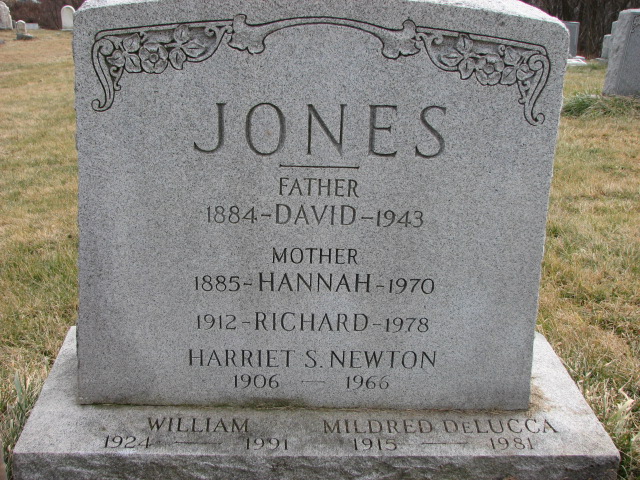
Yes, lies. We all believe them, whether we realize they are untruths or not. For instance, when I was five years old my grandmother was killed by a drunk driver as she stepped foot onto the curb. For years I had remembered part of a conversation I overheard shortly after her funeral regarding her grave marker.  She was the first female child of David and Hannah (Rowlands) Jones to die, and she was buried in the Jones family plot.

The grave marker was engraved with the surname JONES. My grandmother's  married name, however, was NEWTON. It seemed that it had been proposed that her name be engraved on a separate stone with the surname facing the opposite direction. That is what my mother and I had always believed had happened. In fact, I thought that I had seen such a stone when we went to the cemetery for my grand aunt Hannah (Jones) Holden's interment.

In fact, no such stone ever existed. It wasn't until some years later that a cousin connection through Ancestry.com led me to this photo of the grave marker which verified that my grandmother's name had actually been engraved at the bottom of the family gravestone: Harriet S. Newton, 1906-1966. (Now if I could only find out what the initial "S." represents.) I had no idea that this was, in fact, a lie that I had believed because I did not have access to the truth and had only overheard a passing conversation and built a perceived reality around it.

What incidents of Isaac Carter's early life wounded him and caused him to believe a lie?
Wounds which distort our perceptions of reality do not have to be caused by severe traumas. They can result from issues such as the lack of strong, lasting friendships...betrayals...rigid parents who instill negativity which erodes their confidence and cripples their ability to perform...or a host of other events that many of us might take for granted, but which scare the child early in life.

While it's obvious that his youngest brother's seizure disorder, the death of his parents, his grandfather's declining health, the separation of the family resulting in the four youngest children being apprenticed to Master William Temple each would have been enough in itself to wound young Isaac, there must have been other incidents common to children in general, as well those created by living within the regional, racial and economic boundaries of that era, that could have exposed an area of vulnerability.

It is impossible to know just how these soul wounds may have affected young Isaac as he matured, but it would not be unreasonable to think that he may have developed a fear of abandonment to some degree. Many times these children mature into adults who become the mediator, one who wards off conflict, and tend to take on multiple roles within the family. They may lose themselves in some sort of industry, be it work, a hobby or other interest which serves as a distraction. They are known as the one no one has to worry about.

If this were the case, then Isaac's false front would be the mask of self-reliance which would hide an intense fear of depending on others. Once a deep attachment is formed, i.e. friends, marriage and children, he would inwardly worry excessively that the relationship might end in illness and eventual death. It might also take the form of a fear of financial hardship should he become incapable to provide for his family due to illness or death.

Now that we've gotten to the core of our protagonist, the next step is to determine how these motivators shape the plot of our story....

Thursday, September 6, 2012

Who are the Characters in YOUR Family History?

Ancestors as Characters
Have you ever thought of your ancestors in terms of Characters in your family history? I have to admit that when I first started out on this journey to write a family history memoir, I first had to narrow down which story I wanted to tell, and once I decided that, I had to begin thinking of our ancestors in terms of characters within the book. After all, when you pick up a book, what is it that grabs your attention and entices you to continue reading? For me it's getting to meet the protagonist within the first couple pages and witness his/her reactions to whatever it is going on in the midst of the action.

Okay. So, we've established that our protagonist is going to be Isaac Carter.
Actually, our protagonist will change over time as we move from generation to generation. But at the onset, our principle player will be young Isaac (14).

Now, who else is in this story? The next set of people I looked at were his siblings who were also apprenticed. They would be:

  • Nancy Matilda Carter (10)
  • Annanias Carter (8)
  • Zach Carter (5). (He is referred to sometimes as Zacchaeus and at other times as Zachariah, hence the nickname, Zach.)
From there I began to think of who else would appear in the first scene. William Temple, their master, would be there. And depending on where I started the first scene, perhaps the boatman, Stephen Priestly, would be present. 

Once they arrived in New Bern, there would be those at the friend's home or rooming house where they lodged. 

At the Court of Pleas and Quarter Sessions, there would be the Clerk of Court (J.G. Stanly) and the Judge (Justice of the Peace, William Blackledge). And also would be the other persons appearing in court that day.

There would be mention of the children's family: Kelsor and Rhoda Braddock, their grandparents; and, their older siblings...and what about their deceased parents?

So, just from this initial bit of brainstorming, I've come up with the following cast of ancestral characters:
  1. Isaac Carter (14), protagonist
  2. Nancy Carter (10), sister
  3. Annanias Carter (8), brother
  4. Zach Carter (5), brother
  5. William Temple, master
  6. Stephen Priestly, boatman
  7. People at the lodging in Newbern
  8. Samuel W. Chadwick, Sheriff
  9. Judge William Blackledge, Justice of the Peace
  10. J. G. Stanly, Clerk of Court
  11. courtroom spectators
  12. Kelsor and Rhoda Braddock, grandparents
  13. Comfort Carter (21), sister
  14. William Carter (19), brother
  15. Mary Ann Carter (15), sister
  16. Isaac Carter, father (deceased)
  17. Rhoda (Braddock) Carter, mother (deceased)
  18. people in the Temple household
From here I must answer three question about each character:
What is his/her core need?
What is his/her greatest fear?
and
What is the character's inward and outward personae?

It might take some time before I complete the answers to these questions for the main characters in the book, but join me here next time when I share with you the answers to these questions for our protagonist, young Isaac Carter, and take a look at the next step in Writing the Family History Memoir.

Thursday, June 21, 2012

Documents which E-X-P-A-N-D our understanding of family history: Part 7

Mapping the trek from North Harlowe to New Bern, NC in 1853
In the past few weeks we've been examining types of documents which help us to piece together our ancestors' story. The starting point was the 1850 U.S. Federal Census where my husband's 2nd great grandparents, Isaac and Rhoda (Braddock) Carter,  lived with their children: Comfort, William, Mary Ann, Isaac, Nancy Matilda, Ananias and Zach.

The next phase took me to the 1860 U.S. Federal Census where the children were living as apprentices in the household of William Temple. . . . and that led to the search for apprenticeship records (1853). From the court order, another document was generated: the indenture.

Following a re-examination of the 1860 Census, I was able to form an idea of how the William Temple household composition might have segregated the children from the main family with the presence of an older black house keeper and a mulatto boatman.

In September 1853, the Justice of the Peace ordered the Sheriff "have before this Court at the next term, Isaac Carter, Nancy Carter, Ananias Carter and Zach Carter free person of colour, and grandchildren of Kelso Braddock and Sarah Braddock who live one mile from William Temple on Clubfoot Creek, Attest, J.G. Stanly" [Endorsed on the back, Justices vs. Orphans to December term 1853"].

The Court date was on December 12, 1853.

The children, accompanied by William Temple, had to travel the distance from North Harlowe to New Bern, NC. Over land by mule wagon in the winter of 1853 would cover approximately twenty-eight miles, across the old Indian path to the post road, then by ferry across the Neuse River to New Bern.

A search of mileage and travel by mule cart estimates that they could travel at a rate of 3 mph for about 24 miles = 8 hours. At the end of this time the mules would have to be rested, or changed. Supposing they were changed. They would then have to travel another 3 miles. However, could it be possible that in the December cold, they might have stopped earlier...or pushed farther without stopping to make it there by evening, the night before their court appearance. Traveling with four children between the ages of 13 and 5 years old would prove a most trying experience.

To make such a trip in mid-December by boat is highly unlikely, even though such a direct route would cut ten miles from the trip.

In order to get a more definite idea of the route to the Courthouse, I looked for a map of New Bern within that era. When browsing the UNC North Carolina Map Collection by County, the first map in the search results was a map of New Bern circa 1820s entitled,  A plan of the town of New Bern and Dryborough: with the lands adjoining contained within the bounds of the original grant to Dan'l Richardson in 1713.  The only other map close to 1853 was Map of the city of New Bern, circa 1866. Assuming that the city would be much changed following the Civil War, I focused on the former.

By zooming in on the map, I was able to print twenty screen shots on legal-sized paper and piece them together to form a full-sized map, measuring 36 x 44 inches. By assembling other background information gathered previously, I was able to locate the old Courthouse at the intersection of Middle and Broad Streets.

My next task will be to find photos of prominent buildings they would have seen along the way...

Friday, June 15, 2012

Documents which E-X-P-A-N-D our understanding of family history, Part 6

Back to the 1860 Census...
My husband recently purchased the DVD collection of Alex Haley's Roots and Roots the Next Generation for me. I remember viewing it the first time around on my parents' black and white television. But years later, as many Americans did, I revisited it on television re-runs . . . and then again when it was released on VHS. That time around I borrowed it from Forbes Public Library in Northampton, MA, and viewed it with our daughter.

But this time, I took note of Haley's treatment of crossing into successive generations. Historical markers, such as the sharecropper houses on the former plantation, began to stir up imaginations within me about my husband's ancestors . . . especially in regards to young Isaac Carter and his apprenticed siblings.

Looking back to the 1860 Census once again . . . I have looked at it many times, and each time I take note of various details.


1860 U.S. Federal Census; 
Goodings, Craven, North Carolina;
Roll: 
M653_894; Pages: 9-10; Images: 18  
& 19.

This time my attention was drawn to household composition:

  1. William Temple (head, 55)
  2. Rhoda Temple (wife. 47)
  3. Henry C. Temple (son, 16)
  4. Hettie Whitehurst (60, w, House Work)
  5. William Thomas (57, w, Methodist Minister)
  6. Benjamin M. Thomas (10, w)
  7. Isaac Carter (19, b, Apprentice)
  8. Nancy Carter (16, b, Apprentice)
  9. Annanias Carter (14, b, [Apprentice])
  10. Zachariah Carter (12, b, [Apprentice])
  11. Nancy Jones (70, b, House Work)
  12. Stephen Priestly (30, mu, Boatman)
I reasoned that in the absence of their parents and grandparents' care, they must have had one of two possible living arrangements:
  • either they lived in a portion of William Temple's home, or
  • they lived in a cabin outside of William Temple's home, under the direct  care and supervision of another African American servant.
As I now interpret this household composition, I am more inclined to believe the latter. It appears that Nancy Jones may have been the grandmotherly figure in their lives . . . the woman who cared for them. 


Saturday, June 9, 2012

Documents which E-X-P-A-N-D our understanding of family history, Part 5

What we can learn from apprenticeship records


Doc 2: CCPL Microfilm MF G.028.2028002


After several weeks of diversionary family research, which took the form of investigating those who lived closest to the Carter and Braddock families, I have assembled more material for later, and returned to the research at hand...apprenticeship.


To the left is a photocopy from microfilm of the original instrument, the apprenticeship indenture, which I have transcribed below:


[Transcription]
STATE OF NORTH CAROLINA)
CRAVEN COUNTY                   )


This Indenture, made the twelfth day of December in the year of our Lord one thousand eight hundred and fifty three between
the worshipful William J. Blackledge Esquire, Chairman and
Presiding Justice of the Court of Pleas and Quarter Sessions of the county aforesaid,
of the one part, and William Temple of the same county,
of the other part, Witnesseth that the said Presiding Justice, in pursuance of an Order
of said Court, doth put, place and bind unto the said William
Temple an orphan named Isaac Carter a free
boy of colour aged 13-- years, with the said William Temple
to live after the manner of an Apprentice and Servant, until he shall attain the age of
twenty-one years. During which time, the said Apprentice his said Master
faithfully shall serve, and his lawful commands gladly obey, and not absent
himself of his Master's service without leave; but in all things as a
good and faithful Servant shall behave.

And the said William Temple, doth covenant, promise,
and agree, with the said Presiding Justice, that he will teach and instruct, or cause to be
taught and instructed, the said Apprentice to read and write, and also the art and
mystery of a farmer, and constantly find and provide
for the said Apprentice, during the term aforesaid, sufficient Diet, Washing, Lodging and
Apparel, fitting for an Apprentice; and also all other things necessary both in sickness
and health, and at the expiration of said apprenticeship, will pay to said Apprentice Six
Dollars and furnish him with a new suit of Clothes and a new Bible.

In Witness whereof, the parties have hereunto set their Hands and Seals, the
          day and year aforesaid,
Signed, Sealed and delivered,
in presence of
J.S. Stanly [signature]                                                his

                                                     William                 X               Temple        [seal]

                                                                                mark

                                                        Will J. Blackledge [signature]                 [seal]

An what comes next, you might ask . . . .
Imagination can take one only so far; and so, I started looking for every substantial clue which might lead me to concrete images to aid me in recreating the courtroom scene for my family history memoir.

What did that courthouse and that courtroom look like to the young Isaac Carter? Besides serving as the Presiding Justice of the Court of Pleas and Quarter Sessions, who was William Blackledge among his peers, and among his neighbors? And J.G. Stanly, the Clerk of Courts . . . what did these men look like? Were there any portraits made of either of these public officials? How many cases were heard that day. . . of what nature . . . and how long into the day did the young Carter children have to wait to have their case brought before the court?

At this point I have no answers; but, I will continue to pursue my leads until I come to some more concrete conclusions.

And what about the terms of this apprenticeship indenture? There is much to imagine there . . . at the age of twenty-one, receiving his new suit of clothes, six dollars and a new Bible. What ever became of that Bible? Did he take it with him when Isaac enlisted in the U.S.C.T. 14th Heavy Artillery in March of 1864? And did it ever pass into the hands of generations to follow?

Now you might begin to understand how I get departed from the state of my original course. I want to explore every avenue before painting his portrait with words.

Tuesday, May 22, 2012

Documents which E-X-P-A-N-D our understanding of family history, Part 4

What we can learn from apprenticeship records

Yesterday we looked at the 1860 Census for Isaac Carter and his siblings, who were apprentices in the household of William Temple, a 55 year old white farmer who lived nearby, and who owned a farm worth $1500 and personal property valued at $700. His wife, Rhoda, was a 47 year old woman who kept house. Their oldest child, Henry C., age 16, was a farm laborer; and their other son,William G., was 14 years old.

The gap between 1850 and 1860 was more than just ten years in a family's lifetime. The parents died...family dispersed. So, the next set of documents to search for were the apprenticeship records. Today we'll examine the first record in the file: a letter from Isaac's grandfather, Kelsor Braddock. Following is a transcription of that letter. All spellings are as found in the original document.

Doc 1: CCPL microfilm: MF G.028.2028002

To the cort of Please and quarter
  sessions Greeting

This is to certify that we Kelsor
Braddock and Sarah his wife
wishes to have the following named
children Bound out to Mr. William
Temple 1 Isaac Carter corlee of the 13 year
of his age 2 Nancy 10 years of age
3 Annias Carter of the age of 8 years
4 Zachariah Carter of the age of 5 years
This last named one has fits and is
But a perish charge
We the above named Kelsor Braddock
and his wife Sarah do certify that we
are the Grand Father and Grand Mother
of the above named Children and we
should have come to court but
for myself Kelsor am sick and has
been for Twelve months so that neither
of us can come to court  the Father &
Mother of these children have both
Deceased and the children is in a situation
to suffer.                             his
                        Kelsor         X     Braddock
                                         mark
                                          her
                        Sarah          X       Braddock
                                         mark

Attest D. V. Dickinson


Monday, May 21, 2012

Documents which E-X-P-A-N-D our understanding of family history, Part 3


What we can learn from the 1860 Census
From this point on we will refer to the youngest Carter child as Zach in order to reconcile the 1850 enumeration of Zacchaeus and the 1860 enumeration of Zachariah.

In 1860, census enmuerators were given fourteen questions to ask citizens, with the only addition being Question 9: Value of Personal Estate.

This is the document which first started me wondering about the church’s influence on young Isaac Carter’s life. In the post entitled, Ministers andpreachers of Township 5: 1860: William Thomas, B.B. Culbreth & Pearce W.Gorell, I began to formulate questions for further church history research.

Goodings, Craven, NC;
Roll: M653_894; Page 10, Image 19.
Goodings, Craven, NC;
Roll: M653_894; Page 9, Image 18. 


Tuesday, January 24, 2012

From Timelining to Calendaring: 100th Post

Have you ever felt that no matter how hard you work on your family history that when you go to put the facts together, it just seems like something's missing? Do you ever feel like the facts are far and few between? Have you ever considered that perhaps THAT is where the story lies...between the dates?

Last year I was having some trouble getting the myriad of facts and dates in order, so I began with constructing a timeline. At that point, I had selected my husband's grandfather, Hezekiah Carter, whom he had never met, as the focal point of the timeline. Hezekiah Carter's Family Timeline covered the dates 1874-1922: the former date being the year of Hezekiah's birth, and the latter date the year of Hezekiah's oldest child's marriage.

Since that time I have decided that the story actually begins with Hezekiah's father, Isaac Carter, since Hezekiah's noted success is seen as a reaction to his father's impoverished upbringing and legacy. Now the timeline begins with the year 1839, the year of Isaac's birth as the fourth child born to parents who died early in life. The second date in the timeline is September 1853, the date of the Sheriff's order for the four orphaned children of Isaac and Rhoda Carter to appear at the Court of Pleas and Quarter Sessions with their grandparents, Kelsor and Sarah Braddock.

But what happened between the years of 1839 and 1853? 

Besides two census records (1840 & 1850), 
no recorded details remain.

Until the time of Isaac's release from his apprenticeship bond to William Temple, dates remain approximately five or six years apart. Suddenly, they begin to fall annually...and then, when Isaac applies for his Civil War Pension File, the dates become regular within a two year span.

My question became:
How do I track the dates in REAL TIME so that I might gain a feeling for what it was like to wait for the response from a letter...
I was actually in church when the revelation came upon me. Noted Bible Study leader Beth Moore had stated in a DVD that the Gabriel was not only the angel of announcements, but he was also the calendar keeper. That resonated well with me. The Calendar Keeper!

After church this past Sunday, I made a trip to my favorite office supply store and purchases three 14-month desk pad calendars similar to this one, and some small white multi-use labels. When I got home that evening, I started the task of affixing the labels over the numbers of each day on the first calendar.

I then went online and Googled "1864 Calendar." The site < timeanddate.com > offered exactly what I was looking for! This site also shows me the cycles of the moon and on what days holiday observances fall. Other calculators are included for:

  • Duration between two dates
  • Date calculator
  • Birthday calculator
  • Seasons calculator, etc.

Now to copy the dates onto my calendar. 

I am anticipating that there will be a more defined space between dates that might help me imagine all the ordinary daily occurrences that took place which made the time seem to drag on. After noting dates directly connected with Isaac and his family, I will add dates of local historical account. And THAT, I believe, will help me to SEE & FEEL just a portion of the passage of time in the life of Isaac Carter.

Thursday, January 12, 2012

Starting Fresh for the New Year

It's been a month since my last post; 
but even though I've been silent, 
I have NOT been idle!

The Conclusion of Dark Salvation
In late December I finished reading Dark Salvation, by Harry V. Richardson.While I had been summarizing my gleanings on the formation of the AME Zion Church as related to the development of post-Emancipation churches in rural Craven County, NC, the final chapters outlined:

  • the fight for ordination of black pastors 
  • and the continual power struggles between Methodist groups -- both black and white,
so they were omitted from the series.


Books for 2012
Under Their Own Vine and Fig Tree: The African-American Church in the South 1865-1900, by William E. Montgomery, is the next book I'll be reading. I have not yet decided if I will post a series on this book, which focuses on the missionary efforts to rebuild the South following the Civil War.

After that I plan on checking the first-hand accounts of AME Zion Bishops Rush, Moore and Hood, as outlined below:

  1. One hundred years of the African Methodist Episcopal Zion Church, by J W Hood
  2. A short account of the rise and progress of the African Methodist Episcopal Church in America, by Christopher Rush
  3. History of the A.M.E. Zion Church in America, by John Jamison Moore
Old discoveries lead to NEW direction . . .
Around the same time I had finished reading Dark Salvation, I started looking through the TEMPLE family history, compiled by T. J. Tolson. A curious entry -- one I know I must have read several times and overlooked -- stood out for the first time. 
Records indicate that William bought one acre of land from Cilas (sic) Richards in June 1854 for $2.00. The deed described the land as Tourneykill's Branch and purchased for a church site (p. 5).
By the first week of the New Year, I held in my hands a copy of the deed shown below:

Craven County Register of Deeds,
Deed Book 1854/Page 353

You might remember that in 1860, the Rev. William Thomas was enumerated in the William Temple household. This deed dated 1854 . . . just one year after Isaac Carter and his younger siblings had been apprenticed to William Temple . . . marked the beginnings of a house of worship for the Methodist Episcopal Church South congregation in North Harlowe. 

When does the research end and the writing begin?
At this time, the bulk of the research is completed. I will begin focusing more on adding to the timeline, and asking myself probing questions about how events in our family history impacted the lives of individuals. My key focus will be on Isaac Carter, my husband's great grandfather. 

You might remember that Civil War Pension File I obtained earlier last year . . . 

more to come . . .

Thursday, December 1, 2011

Dark Salvation: The Beginnings of Separation

When I locate a book related to my research, I start out by checking the index for keywords. Following that I go to the Contents and check chapter titles, focusing on those chapters containing the most keywords. If the book sufficiently interests me I read the entire book; but even then, I may skip over some chapters and go back to them at a later date. Here I have skipped over Chapter IV: Methodism and Slavery, and continue on to Chapter V: The Beginnings of Separation.

While the former chapter may deal with some aspects of collateral families who migrated to North Harlowe following Emancipation, at this point I am most interested in the community's worship before that time. . . when  my husband's great grandfather Isaac Carter and his three younger siblings resided as apprentices in the William Temple household (1853), following the death of their parents.


from Colton's New Topographical Map
of the Eastern Portion of the
State of North Carolina (1861)
According to Mr. Ralph Berlyn Temple of Newport, NC:
Craven County records indicate that William Temple purchased "1,000 acres more or less" at the mouth of Clubfoot Creek and Neuse River on November 27, 1841 from Joseph Davis for $1,000.00 . . . . (p. 4).  
. . . . and it was on Temple's Point Road that Piney Grove AME Zion Church was erected.

Varieties of segregation in worship services

As I read through this chapter, I was especially drawn to the conditions of participation "after 1784 when Methodism became a Church with church buildings, a resident, ordained ministry, a more diverse white membership, and a growing black membership" (p. 64). Benjamin Abbott testified that,
At time of family worship, abundance of black people assembled in the kitchen, and the door was set open that they might hear without coming into the parlor. . . (p. 64).
And on August 12, 1792, Joseph Pilmoor wrote to John Wesley,
As the ground was wet they persuaded me to try to preach within and appointed men to stand at the door to keep all the Negroes out till the white persons were got in, but the house would not hold them . . . (p. 64).
In Philadelphia, Richard Allen
joined a Methodist class that met "in the forest"... meeting every other Thursday evening.... Richard not only attended Methodist preaching meetings, but he induced his master to have preaching in his, the master's, home (p. 68).
Richard Allen went on to becoming instrumental in forming the first black Methodist congregation in America in 1794.
Early on in the Ministers and Preachers of Township 5 series, I contemplated a few questions about Isaac Carter's exposure to the faith from the minister William Thomas:

Could it be that my husband's ancestors had been part of a biracial Methodist Episcopal church? Or had they broken away into an independent free Black Methodist Episcopal congregation sponsored by the white church? Had they their own Black preachers by 1879? Or did they still listed to the white minister's sermons on Sunday morning? Another myster to ponder. 

While I may never know for certain, at this point I tend to believe that just prior to Emancipation, there may have been licensed exhorters and preachers in the free black community of North Harlowe, NC; but, the Methodist Society would've been overseen by a white ordained minister, either in residence or itinerant. Early meetings may have been held at William Temple's home. . . or perhaps in the woods. . . or even in a small community church. And, I can only imagine how young Isaac Carter may have been influenced by the presence of a Methodist minister in the household where he was apprenticed. My next task will be to contact Methodist churches in the area to gather additional Methodist history in the area.


For additional reading:
Richard Allen, The Life, Experience and Gospel Labors of the Rt. Rev. Richard Allen, George A. Singleton, ed. (1960)
John Firth, Experience and Gospel Labors of the Rev. Benjamin Abbot (1801)
Amy Muse, The Story of the Methodists in the Port of Beaufort (1941)

Thursday, October 20, 2011

Ministers and preachers of Township 5: 1860: William Thomas, B.B. Culbreth & Pearce W. Gorrel

In the 1860 Census for Goodings District, Craven County, NC, I was able to locate three white Methodist Episcopal Ministers residing within Township 5. One was living in the household of William Temple where my husband's great grandfather* was apprenticed with his siblings following their parents' death.

William Thomas:
1860 Census; Goodings, Craven, NC;
Roll: M653_894; Page 9; Image 18;
 Family History Library Film: 803894.
Since first locating this document some years ago, I have often wondered how much exposure Isaac*, Nancy, Annanias and Zaccheus (recorded here as Zachariah) had to the teachings of the Rev. William Thomas. Only ten years before, Mr. William Thomas was enumerated as a 46-year-old farmer, living with his wife Elizabeth (30), and his children: John (12), Susan (10), William (7), Eliza (2), and Benjamin (0).

What happened during those years that his wife and four oldest children no longer lived with him, and that he and his youngest son no longer lived in their own home? And what events would cause him to leave farming and become a Methodist Episcopal Minister?

After reading the book, Rebuilding Zion: The Religious Reconstruction of the South 1863-1877, by Daniel W. Stowell, my thoughts drifted toward Cousin Hattie (Carter) Becton's emphatic, "We were always Methodist."


Could it be that my husband's ancestors had been part of a biracial Methodist Episcopal church? . . . or had they broken away into an independent free black Methodist Episcopal congregation sponsored by the white church? . . . had they their own black preachers by 1870? or did they still listen to the white minister's sermons on Sunday morning? Another mystery to ponder. . . .

B. B. Culbreth:
1860 Census; Goodings, Craven, NC;
Roll: M653_894; Page 18; Image 36;
FHLF: 803894.
The Rev. B. B. Culbreth and wife, Ada M., were also enumerated in another's household: that of Marcus C. and Margaret Bogay.
Pearce W. Gorrel:
1860 Census; Goodings, Craven, NC;
Roll: M653_894; Page 11; Image 21;
FHLF: 803894.


The Rev. Pearce W. Gorrel was the only Methodist Episcopal to own property (valued at $6,500) in Goodings District in 1860.


Private Martin Black: Revolutionary War Pension File (S41441), Part 2

In March, I shared the transcription of  Private Martin Black's Revolutionary War Pension File , in which he described his service in mo...