Showing posts with label SPELMORE. Show all posts

Wednesday, April 3, 2024

Private Aaron Spelmore (Spellman): Rev War Pension File (S42023), Part 2

In the first post in this series, Private Aaron Spelmore (Spellman), Part 1, I focused on two things: determining the commander of Captain Anthony Sharpe's company and gathering information regarding a possible skirmish at Bacon's Bridge across the Ashley River near the village of Dorchester, South Carolina (now Summerville). Today, I'll examine his claims of participating in the Siege of Ninety Six and the Battle of Eutaw Springs.

The Siege of Ninety Six: May 22 to June 18, 1781

The village of Ninety Six got its name from early 18th-century traders in Charleston who estimated the miles from that location to the Cherokee village of Keowee and Fort George on the Keowee River. I struggled to find sources for this battle that included details about the North Carolina Continentals, though the National Park Service's brief article lists twenty-eight sources.[1][2]

Keeping the objective in mind, we will only focus on the siege portions involving the North Carolina Continentals. Then we'll look into the specifics about the participants. 

Maj. Gen. Nathanael Greene
Cuurtesy of Wikipedia

"Since early April [1781] ...the only three significant British outposts outside of Charleston were Augusta (GA), Georgetown (SC) and Ninety Six (SC)." Major General Nathanael Green had received intelligence about the fall of Fort Granby on May 15th, and he headed toward Ninety Six for he hoped that by taking the village he could loosen the British grip on the backcountry. When he arrived on the night of the 22nd, the General ordered the troops to build an earthworks for a three-gun battery, 130 yards from the enemy's redoubt and opened fire on the 24th.[3][4]
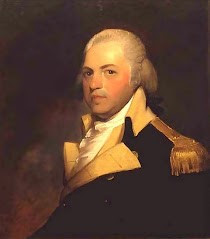
Lt. Col. Henry Lee 
Courtesy of Wikipedia

When Lt. Col. Henry Lee arrived with his legion on June 8th, General Greene's troops ere preparing for an attack from the east, but Lee suggested they attack from the west side. Greene adapted his plan, calling for a three-pronged attack to begin at noon on June 18th: Lt. Col. Richard Campbell led the Virginia and Maryland Continentals of the east side of Ninety Six, and Lee's Legion, along with the North Carolinians and Delaware Continentals, on the west, "Captain Michael Rudloph [of Lee's Legion] led his troops forward, crosses the moat, and after an hour of fighting forced his way into Fort Holms," which progected the enemy's water supply.[5] [6] No other mention of the North Carolinians' participation is included in either of these accounts until they were ordered with Lee's Legion and two other detachments to harass the enemy's rear on their retreat.[7]

Commanders and Officers

According to J.D. Lewis, Lee's Legion and the Delaware Continentals were assisted by the "1st NC Regiment of Continentals detachment led by Major Pinketham Eaton with 66 men in the following four (4) known companies led by: Capt. Alexander Brevard, Capt. Thomas Donoho, Capt. Joshua Hadley, Capt. William Lytle."[8]

Captain Anthony Sharpe's company was not included in this sixty-six-man detachment, so I wonder where the rest of the 1st North Carolina Regiment was posted during the siege. And why would Private Aaron Spelmore declare his service at Ninety Six if his unit wasn't present? 

The Battle of Eutaw Springs: September 8, 1781

Eutaw Springs was a delightful spot near Nelson's ferry, just off the road leading to Monck's Corner. It had received its name because of two springs that boiled up from an underground stream and then flowed into Eutaw Creek. The creek ran between steep banks covered with heavy thickets of blackjack oak until it emptied into the Santee near the ferry.[9]

At 4:00 a.m. on September 8, 1781, General Greene's troops broke camp and headed to Eutaw Springs, marching in four columns in intense heat, having had few rations and little sleep.

The first column was headed up by Lt. Col. Henry Lee and Lee's Legion followed by the South Carolina state troops commanded by Lt. Col. John Henderson. The second column was the North and South Carolina Militia under the command of Brig. Gen. Andrew Pickens and Brig. Gen. Francois de Malmedy. The Third column was three Continental Brigades: the Marylanders under Col. Otho Williams, the Virginians under Lt. Col. Righard Campbell, and the North Carolinians under Brig. Gen. Jethro Sumner.[10]

Private Aaron Spelmore would have been part of this last unit with Capt. Anthony Sharpe's company of the 1st North Carolina Regiment, at the tail end of the third column commanded by General Sumner. Using "the Cowpens pattern," the front line of the less experienced militia was followed by the second line of more experienced soldiers. Brigadier General Francis Marion's South Carolina militia formed in the front line on the right, General Malmedy's two battalions of North Carolina militia were positioned in the center, and General Pickens' South Carolina militia on the left. "Captain-Lieutenant William Gains, who had just arrived the night before with dispatches from Lafayette was in charge of the two three-pounders in the center of the first line."[11]

The 350 men of the North Carolina Brigade under General Sumner formed on the right side of the second line. Lt. Col. Campbell's 350 men in two battalions of the Virginia Brigade were in the center. The 250 men of the Maryland Brigade under General Williams were on the left, and their two six-pounder cannons were in the center of the second line under Capt. William Brown of the 12th Company, 1st Virginia Artillery Regiment. The right flank was occupied by Lee's Legion, and on the left flank were Lt. Col. John Henderson's New Acquisition District Regiment of Militia (SC), Lt. Col. William Washington's cavalry of the 3rd Virginia Regiment Light Dragoons, and Capt. Robert Kirkwood's Delaware Company of the 1st Maryland Regiment in reserve.[12] [13] [14] [15]

Heavy fire through the woods caused the center of the Patriot line to cave, while the right and left flanks fought separate battles. General Greene restored the center with the North Carolina Continentals. The British line sagged, but their reserves rushed them and forced the Patriots to retreat. The British shouted as they rushed forward in disorder, and seeing this, "Major General Greene (according to J.P. Petit) 'brought in his strongest force: The Maryland and Virginia Continentals. and Kirkwood's Delawares, and Lt. Colonel Washington's South Carolina [sic Virginia] cavalry . . . with devastating effect.'"[16]

"Brigadier General Francis Marion's [South Carolina] Militia units fired seventeen (17) rounds - near the limit of their flintlocks endurance. Then, with ammunition exhausted, they retired in good order, leaving the fighting to Brigadier General Jethro Sumner's [North Carolina] Continentals. . . . [who] moved forward with spirit. As the Patriots advanced, the left of the British line fell back in disorder, and Lt. Col. Henry Lee, wheeling his infantry upon them, increased the enemy's confusion . . . British regulars meeting Continentals in hand-to-hand fighting, bayonets meeting bayonets, and swords on swords. . . . when the Marylanders delivered a terrific fire, the whole British line, except for Major Majoribanks flankers, sagged, faltered, and began retreating."[17]

Once the British fled, the Patriots rushed into their camp and devoured the uneaten breakfast they had left behind. They plundered the food stores, liquor, and equipment, confident that they had won the battle; however, by letting down their guard too soon, they were unaware of a new attack that set them to flight. The battle raged for over four hours in unrelenting heat until it was called a draw. Major General Greene gathered his wounded and returned to Burdell's Tavern, seven miles away. The British remained the night and retreated toward Charleston, "leaving behind many of his [Lt. Col. Alexander Stewart's dead unburied and seventy of his seriously wounded."[18]

Tuesday, April 2, 2024

Private Aaron Spelmore (Spellman): Rev War Pension File (S42023), Part 1

Image 6 of 8
Aaron Spelmore's Declaration claims that he enlisted on May 5, 1781 in the state of North Carolina in the company commanded by Captain Sharpe in the 10th North Carolina Regiment, commanded by Colonel [blank] in the line of the Continental Establishment and served until April 5, 1782 when he was discharged at Wilmington.

It also states that he served at:
  1. the Battle of Bacon's Bridge (?),
  2. the Siege of Ninety Six (May 21 -June 19, 1781) and
  3. the Battle of Eutaw Springs (September 8, 1781).
So, now we begin the task of identifying
Image 7 of 8

officers, their service assignments, and researching the battles.

The officers, 1781-1782

Captain Anthony Sharpe

On June 1, 1778, Captain Anthony Sharpe was transferred to the 1st North Carolina Regiment.[1]

The Commanders

The known commanders for the 1st North Carolina Regiment were:
  • Col. James Moore,
  • Col. Francis Nash,
  • Col. Thomas Clark, and
  • Lt. Col. William Lee Davidson.[2]

Colonel Francis Nash & Colonel James Moore

Nash was commissioned as Brigadier General on February 5, 1777 after Brigadier General James Moore became gravely ill, and died subsequently on April 15, 1777, from a severe attack of Gout in the stomach.

Colonel Thomas Clark

Another Colonel we've read about in conjunction with the service of Private Isaac Perkins and Private Martin Black was Colonel Thomas Clark, who served in New York during the Philadelphia Campaign. But Clark was present at the Siege of Charleston and captured when the town surrendered on May 12, 1780. He was a POW until released on November 26, 1782.

Lieutenant Colonel William Lee Davidson

We briefly looked at Lt. Colonel William Lee Davidson in the post, Private John Carter (Caster): Verifying Claims in a Rejected Pension File (R1749), concerning Captain Michael Quinn's company, 1778-1779. Now our timeframe is 1781-1782. According to J.D. Lewis' bio of him, "Brig. Gen. (Pro Tempore) William Lee Davidson led the Salisbury District Brigade of Militia at the battle of Cowan's Ford on February 1, 1781, where he was killed by a British sniper...."

So, how can it be that none of these Colonels was commanding the 1st North Carolina Regiment in 1781-1782? 

Searching for the unidentified commander may have been a mistake until after researching the battles. 

The "Battle of Bacon's Bridge"

Three sources provided limited information about the bridge and its military importance. Bacon's Bridge, nearly thirty miles from Charleston, was the first downstream crossing over the Asheley River. In February 1780, General William Moultrie built a redoubt--a temporary fortification, usually square--on high land on the east side of the river to defend the bridge from the enemy's approaches to and from Charleston.[3] [4]

The old Congregational church known as the White Meeting House--"the social hub of Colonial Dorchester"--was just over a mile from the bridge. For that reason, it was feared that during the British occupation of Charleston (May 12, 1780-December 14, 1782) there was potential for a sneak attack on the village. They also feared that the bridge could be used to access the backwoods route toward Georgetown, the largest village in South Carolina.[5]

"On July 14, 1781, Dorchester was occupied by Col. Lee ('Light Horse Harry') with his legion, capturing many horses and a good supply of ammunition."  Lieutenant Colonel Henry Lee III, brother to Major General Charles Lee, was nicknamed "Light Horse Harry" because of his expert horsemanship and commanded Lee's Legion. He served at the Siege of Ninety Six and the Battle of Eutaw Springs under Major General Nathanael Greene.[6]

In an architectural survey that provides the history of Fort Dorchester, Richard F. Carrillo gives a bit of history of the fort, including added information about this occurrence on July 14th. Following the Fall of Charleston in May 1780, Dorchester was fortified by the British. The author cites Edward McCrady, The History of South Carolina in the Revolution, 1780-1783, MacMillan & Company, New York, 1902, pages 326-328), and continues: 
Lt. Col. Henry Lee, Wikipedia
"During the Partisan campaign against British outposts during the spring and summer of 1781 Dorchester was attacked on July 14th by Colonel Henry 'Light Horse Harry' Lee, supported on the east by Colonel Wade Hampton, who was to cut off communication with the garrison at Monck's Corner and between that place and Charleston. When Lee arrived at Dorchester, he did not encounter the expected resistance due to a greatly reduced garrison which evidently had fled, leaving behind a number of horses and several wagons, one of which contained much-needed ammunition."[7]

At this time, the 1st North Carolina Regiment was attached to Lee's Legion, and this skirmish at Bacon's Bridge most likely took place after the Siege of Ninety Six, when Dorchester
was again occupied by the British when Gen. Greene concentrated his troops prior to the movements resulting in the battle of Eutaw Springs [in September]."[8]
Lt. Col. John B. Ashe, Wikipedia[9]
Hugh Rankin states that Lieutenant Colonel John Baptista Ashe's group combined with Major General Nathanael Greene's and the draftees from the Salisbury district into the reorganized 1st North Carolina Regiment. Thankfully, Rankin sourced his writings well, and in the State Records of North Carolina (Vol. 15, p. 533), I found the orders of General Sumner to Lieutenant Colonel John B. Ashe dated July 14, 1781, putting him in command of all North Carolina Continental Troops, including those under Major John Armstrong, incorporating them into the 1st North Carolina Regiment, of the four existing regiments. The next to be reorganized was the 2nd North Carolina Regiment.

Major General Nathanael Greene's troops took back control of the bridge and camped there in March of 1782 while the British occupied Charleston. It was used as a rest and staging area for American troops who held control until July. From these three articles, there was only one mention of an original source: The Papers of General Nathanael Greene, which I should make a trip to Amherst College to examine Volume 10.[10]

Next time I'll examine the battle histories of the Siege of Ninety Six and the Battle of Eutaw Springs in hopes of gaining clarity of Private Aaron Spelmore's Revolutionary War service.

Thursday, April 10, 2014

Asa Spelmore: American Revolution Pension Declaration, Part 4

The final correspondence in Asa Spelmore's pension file represents the final attempt to gain a soldier's pension for service in the Revolutionary War. It appears that a pension was never granted, and the case, having been brought to court twice, was left unresolved.

Asa Spelmore: Image 13
www.Fold3.com
42022
INVALID.
Rev
File No. 42022
Asa Spelmore
Pri    Rev War
---------------
Act. 18th March 18th
Index:--Vol. [G?], Page 483
[Arrangement of 1870.]


Asa Spelmore: Image 14


Hon.: Wm S. Black-
ledge -- [Ho: Repo]
[Recd] between 21st Jan y
----------------------
Asa Spelmore
Old Rev y case

The Honorable
Wm. S. Blackledge
Washington City


Asa Spelmore: Image 15


Newbern 15 Jan : 1822
Dear Sir,
   Apon old man, Asa Spellmore, one of
your Constituents applied some time since for a provision on the ground of Revolutionary Service. His petition was returned for more specific statement of citizenship & the Oath of Mo H Davis, Sheriff of the County was added. . And the papers again forwarded to the War office -- Since then nothing has been heard of his case-- I have obtained from the Clerk's Office, a Copy of his petition, & proof & enclose it to you-- & hope you will in person hand it to the proper office & obtain an early decision on his case.
He is miserably poor & cannot t[ay] the Government long -- but while others with no better claims are relieved. it is hard this old fellow should be [competent] to [beg] his head.
Your obed "Serv"
J. Stanly


Asa Spelmore: Image 16


James L. Edwards Esqr
Pension Office


Asa Spelmore: Image 17


Sir

     Mr. Blackledge had the honor to
lay before Mr. J. L. Edwards a letter from Mr. John Stanly [                 ] the claom of an old Soldier for a pension under Government -- At the time this claim claim was [     ] before you I reserve promise of an answer as soon as the claims previously presented should hear under your examination --- if the claim which was presented February 2nd has not yet been examined --- I should like to be informed when it is possible --- it will [come] in course for ex-amination.
Yours Respectfully
March 25th, 1822
W S Blackledge


Asa Spelmore: Image 18


Newbern

17,542
Asa Spelmore
-----------
Thos Watson
Newbern, N.C.
--------------
Recd 29 June 1822


---------------------------
free
                      The Honorable
                          The Secretary of War
                                   (Pension Office)
                                   Washington City


Asa Spelmore: Image 19


Some fatality attends the petition of the 
poor old Soldier Asa Spelman. His first
petition miscarried -- His second was retur:
:ned & several months have elapse before he
could be brought to Court to add the sup:
:plemental matter required --- It is now
again entered & he entreats an early
reply, addressed to Thomas Watson Esq.
Port Master, Newbern -- No. Car.--
      June 15, 1822                                    

Sunday, April 6, 2014

Asa Spelmore: American Revolution Pension Declaration, Part 3

Following the testimony of Asa Spelman and the affidavits sworn by fellow patriots John Carter and Isaac Perkins, the Clerk of Court, J G Stanley, certified the statements as being true copies from the original record.--------------------------------------------------------------------------------
www.Fold3.com
Asa Spelmore: Image 7
Asa Spelmore
    ----------
Thomas Watson
      Agt.
Newbern, N.C.
    ----------
Rec'd June 1821


certificate amended

[ Asa Spelman is ----
N.Carolina and proobably
should be Asa Spelmore
-----  ---  ------------]

Thos Watson
Newbern
N.C.


Asa Spelmore: Image 8
district of North Carolina)  Court of Pleas and Quarter
Craven County                  )   Sessions - September 1820
On this 13th day of September 1820 personally appeared
in open Court, the said Court being a Court of Record
proceeding according to the course of the Common
law, with a jurisdiction unlimited in point of amount,
keeping a record of its proceedings, and having power to
fine and in prison Asa Spelmore commonly called
Asa Spelman, aged Seventy four years, who being first
duly sworn according to law, doth on his oath make the
following declaration, in order to obtain the pension
made by the Act of Congress of 18th March 1818, and the
1st of May 1820, that he the said Asa Spelman enlisted
in the Company commanded by Captain Quinn, in the Tenth
North Carolina Regiment, Continental Establishment command:
=ed by Colonel Davidson--that he enlisted for nine months
and served his term, but cannot state the day of his
enlistment or discharge--He was discharged at Halifax in
No. Carolina. He was not in any engagement except on
skirmish near West Point, and at King's Ferry in Jersey.
He has no other evidence of his service in his power than the
annexed affidavits of Isaac Perkins and John Carter.
And in pursuance of the Act of 1st May 1820 I do solemnly
swear that I was a resident citizen of the United States on
the 18th day of March 1818, and that I have not since that
time, by gift, sale, or in any manner, disposed of any property,
or any part thereof, with intent thereby so to diminish it
as to being myself within the provisions of an Act of Congress
entitled "An Act to provide for certain persons engaged in the
land and navel service of the United States, in the
Revolutionary War," passed on the 18th day of March 1818.
and that I have not, nor has any person in trust for me,
any property or security, contracts or debts due to me, nor
have I any income or any property, except one
Canoe and paddle. Declarant is by occupation a

Asa Spelmore: Image 9
Cooper, but from age and infirmity he cannot work but little.
He has no family and resides with his brother.
Sworn to and declared                                  his
on the 13th day of September           Asa     X       Spelman
1820 before                                                 mark
J G Stanly Clerk

Isaac Perkins maketh oath that he was a private
Soldier in the Second Regiment, North Carolina line in
the Continental establishment in the War of the Revolu:
:tion -- that while on Service at White Plains in the
State of New York, a detachment of Continental troops
[passed] that place on duty, and [       ] then he saw
the petitioner Asa Spelman or Spelmore, whom he
had been long acquainted with in No Carolina -- that
said Spelmore was then serving as a Continental Soldier
but deponent does not know the length of his service.
deponent was at the battle of Monmoth and at the
Siege of Charleston ----                          
Sworn to & subscribed in                        
Open Court September                                  
J G Stanly Clerk                                      his
                                                       Isaac   X   Perkins
                                                                mark


John Carter, a Citizen of Craven County in the State
of North Carolina, maketh oath that he enlisted
in the Company Commanded by Captain Quinn
in the Regiment Commanded by Colo Davidson
(the Tenth) in the Continental North Carolina

Asa Spelmore, Image 10
line, Continental Establishment, during the War
of the Revolution, and served nine months, and depo:
:nent knows that Asa Spelman was a soldier in
the Same company and that he said that Spelman did
serve the term of nine months in that Company.
                                                                 his
Sworn to and subscribed in  )          John  X  Carter
open Court September 13th )               mark
A.D. 1820                              )
                        J G Stanly  Clerk

State of North Carolina
Craven County
I James G Stanly Clerk
of the Court of Pleas and Quarter 
Sessions of Craven County do hereby Certify
that the foregoing oaths, and the schedules
thereto annexed are truly copied from the 
records of said Court, and I do further certify
that it is the opinion of the said Court, that
the total amount in value of the property
exhibited in the aforesaid schedule is
considerably less than one hundred dollars.
In Testimony whereof I have 
hereunto set my hand and affixed
the Seal of the said Court on this 13th
day of September A.D. 1820.
J G Stanly   Clerk
of the Court of Pleas and Quarter
Sessions of Craven County,
State of North Carolina
in the Court of Pleas & Quarter
Sessions for Craven County March
Term A.D. 1821 --
Thomas [H.] Davis [County Sheriff of]
Craven County appeared in open Court and maketh
oath that he is well acquainted with Asa
Spelmore or Spelman that said Asa is


Asa Spelmore, Image 11
[top]
at this time and has been for many years
a resident Citizen of this County, and that he is
the same person who has applied for a pension
Sworn and subscribed before me
14th March 1821[in open court] Thomas H. Davis
J G Stanly CC
                                         It is ordered that the Clerk certify to
the Secretary at War, of the United States that the
Witnesses [      ] support of the petition of said Asa Spelman
or Spelmore are worthy of merit. Witness James
G Stanly Clerk of said Court under the [     ]
of said Court at Newbern [       ] 14th day of March
A.D. 1821                                     J G Stanly   CC


[middle: See Image 7 above]

[bottom]
Asa Spelmore is not mustered. I find the name of
Asa Spelman a private in Capt Quinn's Comp y of the 10th
Regt for 9 months, enlisted 20th July 1778, which is believed
to be an error and that is should have been Asa Spelmore.
                                               Given under my hand this 12th Dec
                                               1820                            Wm Hill, Sec ry


Asa Spelmore, Image 12 (See: Image 11, bottom)


Thursday, April 3, 2014

Asa Spelmore: American Revolution Service Declaration, Part 2

Continued from Cross-Referencing Pension Files: The Revolutionary War Pension File of Asa Spelmore, 31 March 2014

[The following two images are a continuation of the previous sworn testimony.]
------------------------------------------------------------------------------------------------------------

www.Fold3.com
Asa Spelmore, Image 5
John Carter a citizen of Craven County in
the State of North Carolina maketh oath
that he was enlisted in the Company [when?]:
mustered by Captain Quinn, in the Regiment
commanded by Colo Davidson (the [?])
in the North Carolina line Continental es-
tablishment during the War of the Revolution
and served nine months and deponent
knows that Asa Spelman was a soldier in
the same company and that the said
Spelman did serve the term of nine months
in said company.  signed                his
                                              John    X    Carter
                                                         Mark
It is the opinion of the Court that the
total amount in value of the property cohab-
ited in the aforesaid schedule is considerably
less than one hundred Dollars--
Craven County Court of Pleas & Quarter
Sessions.     March Term A.D. 1821--
Thomas A Davis Esq. Sheriff of Craven
County appeared in open Court and made
oath that he is well acquainted with
Asa Spelmore or Spelman that said Asa
is at this time and has been for many years
a resident Citizen of this County and that he
is the same person who has applied for a
pension. And it is Ordered that the
Clerk Certify to the Secretary at War of 
the United States, that the Witnesses in
support of the petition of the said Asa
Spelman or Spelmore are worthy of merit.


Asa Spelmore, Image 6
State of North Carolina
Craven County
I James G Stanly, Clerk of the
Court of Pleas and Quarter Sessions
of Craven County do hereby Certify
that the foregoing affidavits and
the schedule thereto annexed are
truly copied from the records of
Said Court.
In Testimony whereof
I have hereunto set my hand and
affixed the seal of said Court
at Newbern this 15th day of
January A.D. 1822.
J S Stanly  CC

State of North Carolina )
       Craven County         )
             Court of Pleas & Quarter Sessions
May Term A.D. 1822.
Asa Spelmore or Spelman maketh oath
in open Court that he has endeavored to ascertain
the time of his entering the service, and the time
of his leaving it--and is now able to declare
that he entered the Service at Smith's Creek
in Craven County, No Ca on the 20 July in the
year seventeen hundred and seventy-eight--
and was discharged at Halifax, No Ca on
the eighth day of May one thousand
seven hundred and seventy-nine
Sworn to and subscribed in
open Court 15th May
1822. Attest J S Stanly  CC     his                
Asa    X   Spelman
mark               

State of North Carolina
Craven County
I James G Stanly
Clerk of the Court of Pleas and
Quarter Sessions of Craven County hereby
certify that the foregoing affidavit is
truly copied from the records of said
in Court.        In Faith whereof I hereunto
set my hand and affix the seal of
said Court at Newbern this 14th
day of June 1822.
J S Stanly  CC


Monday, March 31, 2014

Cross-Referencing Pension Files: The Revolutionary War Pension File of Asa Spelmore

A good practice when studying pension files is to locate the records of those who made sworn statements in support of a fellow soldier's application. Asa Spelman (Spelmore) had testified on behalf of John Carter on 13 Dec 1820.

Below you will find the first installment of Asa Spelmore's pension application (images 1-4). Because the file consists of a total of nineteen images, it will be treated as a mini-series.

www.Fold3.com
NARA Publication M804
SERVICE                                        NUMBER
N.C.                Spelmore, Asa           S42022
[Left Side]
18-691 R
North Carolina
-------------------------------------------------------
Asa Spelmore
(aged 74)
of Craven Cy in the State of N. Carolina
who was a Private in the Regiment commanded by Colonel Davidson of the N. Carolina
line, for the term of nine months 1778-9
-------------------------------------------------------
Inscribed on the roll of North Carolina
at the rate of 8 Dollars per month, to commence on the 13 of September 1820.
-------------------------------------------------------
Certificate of Pension issued the 1 of July 1822
[Gentle] Thomas Watson Esq.
Newbern, N.C.
-------------------------------------------------------
Arrears to 4th of March 1822  141.83
[s]emi anl all'ce ending 4 Sept 1822   48      
$189.83
{Revolutionary claim,
Act 18th March 1818.}
May 1, 1820
(Not on list)
_____________________________________
[Left Side]
[per call ?] 14 Sept 1831
to the Pensioner


District of North Carolina
Craven County
Court of Pleas and Quarter Sessions
September Term A.D. 1820
On this 13th day of September 1820 personally
appeared, in open Court, the said Court being
a court of record proceeding according to the
Course of the Common Law, with a Jurisdiction
unlimited in point of amount, keeping a record,
of its proceedings, and having power to fine and
imprison Asa Spelmore commonly called
Asa Spelmore, aged seventy four years who
being first duly sworn according to law, doth on 
his oath make the following declaration, in order
to obtain the provision made by the Acts of
Congress of 18th March 1818 and the 19th May
1820 that he the said Asa Spelmore enlisted
in the Company commanded by Captain
Quinn in the Tenth North Carolina Regiment
Continental Establishment Commanded by Colonel
Davidson, that he enlisted for nine months, &
served out his term, but cannot state the day
of his enlistment or discharge, he was discharged
at Halifax in North Carolina. He was not in
any engagement except a skirmish near West
point and at King's ferry in Jersey. he has
no other evidence of his service in his power
than the annexed affidavits of Isaac Perkins
and John Carter. And in [persuance] of the
Act of 19th May 1820. I do solemnly swear
that I was a resident Citizen of the United
States on the 18th day of March 1818, and
that I have not since that time by gift
sale or in any manner, disposed of my property
or any part thereof, with intent thereby so to
diminish it as to bring myself within the
provisions of an "Act of Congress entitled
An Act to provide for certain persons engaged
in the land and navel service of the 
United States, in the Revolutionary War passed
on the 18th day of March 1818. And that
I have not , nor any person in trust for me, 
my property or securities, contracts or debts owed
to me, nor have I any income or any property
except one Canoe, one paddle, declarant is
by occupation a Cooper, but from age &
infirmities he can work but little. He has
no family and resides with his brother.
Sworn to and declared, (signed)                 his                   
on the 13th day of)        Asa   X    Spelmore
September 1820)              mark                  

Isaac Perkins maketh oath that he was a
private soldier in the 2nd Regiment North
Carolina line in the Continental establishment in
the War of the Revolution, that while on service
at White Plains in the State of New York
a detachment of Continental troops [                ] that
place on duty, and among them he said the
the petitioner Asa Spelman or Spelmore whom he
had been long acquainted with in No. Carolina
that said Spelmore was then serving as a
Continental soldier, but deponent does not know
the length of his Services, deponent was at the
battle of Monmouth and at the seige of
Charleston.                      his                         
(signed)    Isaac      X     Perkins        
mark                       


Sunday, March 30, 2014

Craven-Carteret County List of Declarations of Service Accompanying U.S. Pension Applications

--as extracted from Camin's "Declarations of Service" List (Box 7-14), 
State Archives of North Carolina

One of the most helpful tools when doing preliminary searches for primary documentation at an archives are the finding aids found on each repository's website. The North Carolina State Archives "Military Collection Finding Aids" contain lists of information grouped first by century, and then by conflict. They range from the Spanish Invasion Collection, 1742-1748 to the Iraq War Papers, 2001-2010. Each link opens into a PDF document which records each collection organized by box number and contents.

The following is an extraction, containing the names, dates of pension application, and the county in which they were filed. Altogether there are twenty-six applications from Craven County and one from Carteret County.


  1. Martin Black* (1820), Craven
  2. Furney Cannon (1853), Craven
  3. John Carter* (1820), Craven
  4. John Cox (1820), Craven
  5. Levi Dawson (1838), Craven
  6. Sacker Dubberly (1832), Craven
  7. John Gregory* (1832), Craven
  8. Samuel Ipock (1832), Craven
  9. John P. Ives (1832), Craven
  10. James Jones (1820), Craven
  11. Daniel Lane (1833), Craven
  12. Absalom Martin* (1820), Carteret
  13. Enoch Masters (1832), Craven
  14. William Morgan (1821), Craven
  15. Edward Nelson (1832), Craven
  16. Isaac Perkins* (1829), Craven
  17. Isaac Reed (1799), Craven
  18. Isaac Sampson (1820), Craven
  19. Aaron Spelmore* (Spelmen) (1820), Craven
  20. Asa Spelmore* (1820), Craven
  21. Peter Vendrick (1832), Craven
  22. William Warren (1821), Craven
  23. Robert L. Whitaker (1832), Craven
  24. Benjamin White (1832), Craven
  25. Rev. Rufus Wiley (1832), Craven
  26. Solomon Witherington (1832), Craven
  27. William Witherington (1832), Craven

Please note that all free persons of color are denoted with an asterisk (*) beside their name. Also, these are applications from those who served on the Continental Line. Others who served in the North Carolina State Militia are not represented here. Omission of a soldier's name from this list does not mean that there is no service record for that particular soldier--just that there was no application for pension made.

Revolutionary War Pension Files, the originals which are housed at the National Archives and Records Administration (NARA) in Washington, D.C. [Publication Number: M804, Revolutionary War Pension and Bounty-Land Warrant Application Files, Catalog ID: 300022, Record Group: 15.], may be viewed at www.fold3.com.

Another interesting collection of Craven County documents found at the North Carolina State Archives are the Loyalist Records. For Craven County, there are two sets of files:

C.R. 028.301.12-13 County Court Minutes, 1776 (?)-1784. Part I contains proceedings in treason hearings by the state; Parts I and II contain matters related to confiscated property, 1778-1784.
C.R. 028.928.13. State v. Jethro Oates (1780), trial for treason. 


Private Martin Black: Revolutionary War Pension File (S41441), Part 2

In March, I shared the transcription of  Private Martin Black's Revolutionary War Pension File , in which he described his service in mo...