Showing posts with label North Carolina. Show all posts

Tuesday, May 27, 2014

Isaac Perkins: Revolutionary War Pension Application File: Part 4

An addition to my LibraryThing.com
When I began my in-depth research on the battles and skirmishes in which our free black Patriots from Craven County, North Carolina had participated, I came across a book title contained within an end note of a book on the Battle of Monmouth Courthouse. I quickly checked on the Barnes and Nobel and Amazon.com sites to compare availability and prices and found what I was looking for! Not only was I able to purchase a "Like New" hardcover copy of this book, but much to my joy, it arrived at my mailbox two days later!

Available at Amazon.com
The book's title is, The North Carolina Continentals, by Hugh F. Rankin. Check it out on Amazon.com's "Click to Look Inside!" feature. It appears to be quite thorough in its footnotes and bibliography, which is great for me, because I'm always checking sources to glean additional details.

Contained within its twenty chapters, I found information concerning every battle in which the free black Patriots of Craven County, North Carolina had fought. I'm looking forward to this being a very good read!


Part 4 in the Pension File of Isaac Perkins
Isaac Perkins 10/35
www.Fold3.com

[Transcription, page 1]
41 953
Revy INVALID
File No. 41.953
Isaac Perkins
Pvt.  Rev War
----------------
Act. 18 March 18
Index. Vol. 3, Page 890

[handwritten note on right side of document]
1930-Aug 8--Hist. to
Adj. Gen. See 
[N]ewbern copy in 
Misc File under
C. H. Bridges, EEL
----------------

Isaac Perkins 11/35
www.Fold3.com


[Page 2]
1828 papers 
to be filed
with Ad OW
Inv. File# 
41.953
-------------


Isaac Perkins 12/35
www.Fold3.com


 [page 3]
Isaac Perkins   Pvt.
N. Carolina

No. Carolina

Inv. File No. 41.953


Isaac Perkins 13/35
www.Fold3.com


[page 4]
10th Regiment
Isaac Perkins pt. 16th May 1777. 3yrs
The above is a true abstract from the Mus-
ter roll of the North Carolina Continental line
in the revolutionary war.
Given under my hand 10th July 1818
Wm Hill  Secretary
of State


Isaac Perkins 14/35
www.Fold3.com


[page5]
[handwritten notation on left side of page]
See letter to Sec. of War Jan. 6. 1828
See letter Nov. 24. 1829 to S. Gerock
----------------
4,666
North Carolina
Isaac Perkins
private
In the Army of the United States during the Revolutionary War.
Inscribed on the Roll of North Carolina
at the rate of 8 Dollars per month, to commence on
the 9th of June 1818
Certificate of Pension issued the 30th day of November 1818
J. E. Shanlet Esq. Clerk
of the [C--] of Craven Co. N.C.
Arrears of 4th of Sept 1818: 2 26/30 mo. $22.93
Semi-anl. all'ce ending 4 Mar 1819              48      
                                                                        $70.93
{Revolutionary claim
{Act 18th March 1818.}


Isaac Perkins 15/35
www.Fold3.com

 [page 6]
Capt
Saml Gerock
Newbern
N. C.

Came to hand
20th Decr 1819

For Additional Consideration
I have seen the name, Samuel Gerock, several times before in other documents; but, this is the first time I have seen the rank of Captain attached to his name. The link provided and entitled, "North Carolina Pensions, (119-121)" states that he had been employed at the Bank of New Bern. It also details in his pension application that he had enlisted for service in the Revolutionary War in Maryland. An overview of his service record also appears. A brief description of his appearance in latter years can be found here.

Thursday, September 6, 2012

Writing The Family History Memoir

What is a family history memoir?
There seems to be some discrepancy today of what genre our book might fall into: family history?  memoir? historical narrative? or some combination of the above....

Ahnentafel with modified register
 for Isaac Carter
For our purposes here we will agree that a family history is usually a narrative telling of one family, often including female collateral lines. It's scope often begins with the first immigrant in America and continues to the present; however, sometimes it may extend beyond the emigration story to life in the nation of origin. The narrative itself is a compilation of facts extracted from oral tradition and documentary sources, and may contain assumptions and conclusions drawn by the researcher/author. Many family histories conclude with the actual genealogy in an Ahnentafel chart. Here you'll see the first page of our Isaac Carter's ahnentafel with a modified register, which means that the report also includes an index for each child's lineage. An example of an exhaustive family history which I own is the NEWTON GENEALOGY: Being a record of the descendants of RICHARD NEWTON of Sudbury and Marlborough, Massachusetts, 1638, compiled by Ermina Newton Lenoard (1915).

Memoir is usually thought of in terms of a prominent person's reflections on their past, or perhaps of their child's reflection of their famous parent or grandparent's past leading up to their own self-discovery. An example of this genre is found in one of my favorite reads from last year, Missing Lucile: Memories of the Grandmother I Never Knew, by Suzanne Berne (2010).

Family history memoir refers to a descendant researcher's shared discovery of their family history and includes insights and conclusions drawn along the way. It is a personal journey shared with the reader. Most books in this genre limit the scope to just a few generations of interest, usually the author's parents, grandparents and sometimes even great grandparents. Oh Beautiful: An American Family in the 20th Century, by John Paul Godges (2010), is a daring example of a family history memoir which I enjoyed reading this past year.

The historical narrative attempts to show the reader how they lived by placing our ancestors within the context of place, period and society. 1861: The Civil War Awakening, by Adam Goodheart (2011), is a wonderful analysis of the start of the Civil War which transports the reader to the scenes of events and to the thoughts and actions of their prominent players.

Where do I begin?
This book takes place in eastern North Carolina and extends from the antebellum period to the time of the great migration. I will be writing about three generations of my husband's paternal family, beginning with his great grandfather, Isaac Carter and ending with my husband's father. 

I hope you'll stop back in days to come as I share with you the journey of Writing The Family History Memoir.

Thursday, July 19, 2012

Diving Into. . .

File Box 1, File No. 1.4, Part I.1
Franklin, John Hope. "The Free Negro In The Economic Life Of Ante-Bellum North Carolina, Parts I & II," in The North Carolina Historical Review, Vol. XIX, No. 3, July 1942, pp. 239-259; and Vol. XIX, No. 4, October 1942, pp. 358-375.


Apprentice Bonds
As early as 1733 children of free Negro parents were being bound out as apprentices. In that year it was reported to the upper house of the General Assembly that "divers free people, Negroes and mulattoes were bound out until they came to 31 years of age, contrary to the consent of the Parties bound out." . . . On July 12, 1733, the General Assembly passed an act declaring that the binding out of free Negroes against their consent was an illegal act (p. 240).


We've discussed apprenticeship bonds before, especially in relation to Isaac Carter and his siblings. Beyond the historical laws dictating the conditions under which minors could be apprenticed, Franklin provides a table recording the FREE NEGRO APPRENTICES IN CRAVEN COUNTY, 1800-1860.
Of 214 apprentices recorded during this period for Craven County, 32 occupations were represented. The highest occurring occupations were Carpenter (20), Cooper (41), Farmer (26), Shoemaker (13) and Spinner (55). Franklin notes that these occupations were representative of conditions in the county by areas where the labor force needed additional support.
Not infrequently free Negro children were bound out to free Negro masters. It may have been that the more affluent free Negroes took over the children of their less fortunate fellows to prevent their being bound out by the county court to some person with whom they were not acquainted. The records of Craven County show that John C. Stanly, a wealthy free Negro, was continuously binding free Negro children to himself (p. 244).

Further discussion of John Caruthers Stanly can be found here.

By the end of the period, Franklin notes that there had been nearly two-thousand free Negro children working within the homes of white people as apprentices, leading to the emergence of skilled free Negro farmers and tradesmen in the state.

Diving Into. . .

File Box 1, File No. 1.4.Part II.1
Franklin, John Hope. "The Free Negro In The Economic Life Of Ante-Bellum North Carolina, Parts I & II," in The North Carolina Historical Review, Vol. XIX, No. 3, July 1942, pp. 239-259; and Vol. XIX, No. 4, October 1942, pp. 358-375.

Distribution of wealth

As I came to the end of the article, I was reminded of
something I had written in my application for the
NEH Unaffiliated Independent Scholar Fellowship, 2008. . . .

Page 370 displays a table entitled, FREE NEGROES HAVING PROPERTY VALUED AT MORE THAN $2,500, with the commentary,
While this table does not represent the average holdings of the free Negro in ante-bellum North Carolina, it suggests that there was a number of individual cases in which free Negroes rose to a position of economic independence, despite obstacles (p. 371).
The table contains the names, occupations and valuations of estates for fifty-three persons. Below is a table which I created to analyze the raw date within Franklin's work.

Occupation
Number
High
Low
Mean
Baker
1
$2,750
---
---
Farmer
32
20,816
$2,500
$5,601
Barber
2
4,400
3,550
4,025
Farm Hand
2
5,554
3,450
4,502
Cabinet Maker
1
4,000
---
---
Musician
1
3,100
---
---
Carpenter
3
36,000
2,500
14,167
Housekeeper
1
5,500
---
---
Unlisted
4
14,000
2,500
6,425
Confection
1
5,905
---
---
Wheelwright
1
8,150
---
---
Clerk
1
5,000
---
---
Blacksmith
1
2,800
---
---


Most of the free Negroes who owned property were possessors of small estates worth a few hundred dollars or less. . . . Craven County, with 1,332 free Negroes in 1860,had only 179 free Negro property owners. . . (p. 370).
This focus on the exemplary is exactly what I have chosen NOT to include in my work. Our society, made up of average people working side-by-side, is what forms the spirit of community. And, that is what I have chosen to research: the average family, their trials and struggles to form a better community, where family sticks together and neighbor helps neighbor.

Franklin continues. . .
On the whole, a larger number of free Negroes possessed some type of personal property, ranging from silver watches to farming tools. . . . But the poverty of the free Negro group can be seen clearly through this study of the value of the property of the group. They possessed an aggregate wealth of $1,045,643. When one considers that more than 30,000 people had to share in this wealth of slightly more than one million dollars, the realization of their plight is inescapable. The per capita wealth of the free Negroes of North Carolina was only $34 in 1860. Thousands were landless and without any kind of property. 
A second table reports the aggregate value of property owned by free Negroes in North Carolina by county. In 1860, Craven County had an aggregate of real estate valued at $29, 865, and of personal property, $21, 137.


Saturday, July 14, 2012

Diving Into. . .

File Box 1, File No. 1.3:
Farlow, Gale. "Black Craftsmen in North Carolina," in North Carolina Genealogical Society Journal, Volume XI, No. 1, February 1985, pp. 2-13; continued in Volume XI, No. 2, May 1985, pp. 91-103.

I had hoped that this article might discuss the various crafts in which African Americans were engaged in the period pre-1850; however, it served as a synopsis of other researchers' investigations. The author states that
Four factors were considered necessary for identification of black craftsmen working before 1850: name, trade, location by town or county, and at least one documented date. This method necessarily eliminated any referenced not having all four criteria . . . . would seem to indicate that the list of those identified is only a small part of the total number who were working in North Carolina before 1850. . . . Of the 291 craftsmen identified, 159 were free persons and 132 of them were cited as apprentices. The slaves numbered 132 with 94 of them runaways. Forty-four counties were represented, twenty of them east of Raleigh and classified as Eastern, and nineteen were located in the Piedmont area (p. 8).
Farlow cites John Hope Franklin's The Free Negro in North Carolina as the source for this information. On the next page are two tables:

Table 1: Black Craftsmen Listed By Trade
Table 2: Black Craftsmen Located By Counties

Table 2 records fifty-seven black craftsmen in Craven County (p.9).

The remainder of the article is a compiled list of names and notations extracted from apprenticeship bonds, newspaper advertisements, and various other sources. Three of our Carters are listed on page 11:
  1. CARTER, George. A free black, aged eleven years, who was apprenticed as a turner to Thomas IVES of Craven County in 1788. (Craig, p. 355);
  2. CARTER, Isaac. Aged five years he was apprenticed as a cooper to William PHYSICO of Craven County in 1811. (Boykin, p. 19);
  3. CARTER, William. Aged fourteen years, he was apprenticed as a cooper to William PHYSICO of Craven County in 1811. His younger brother (see above) and his two sisters were apprenticed to be trained as coopers at the same time to the same man. (Boykin, p. 19).
Cited Sources:

Craig, James H. The Arts and Crafts in North Carolina 1699-1840. Winston-Salem: Museum of Early Southern Decorative Arts, 1965.

Available at Abe Books
The Boykin source was not cited in the footnotes; but, a little searching of my own revealed the book: 
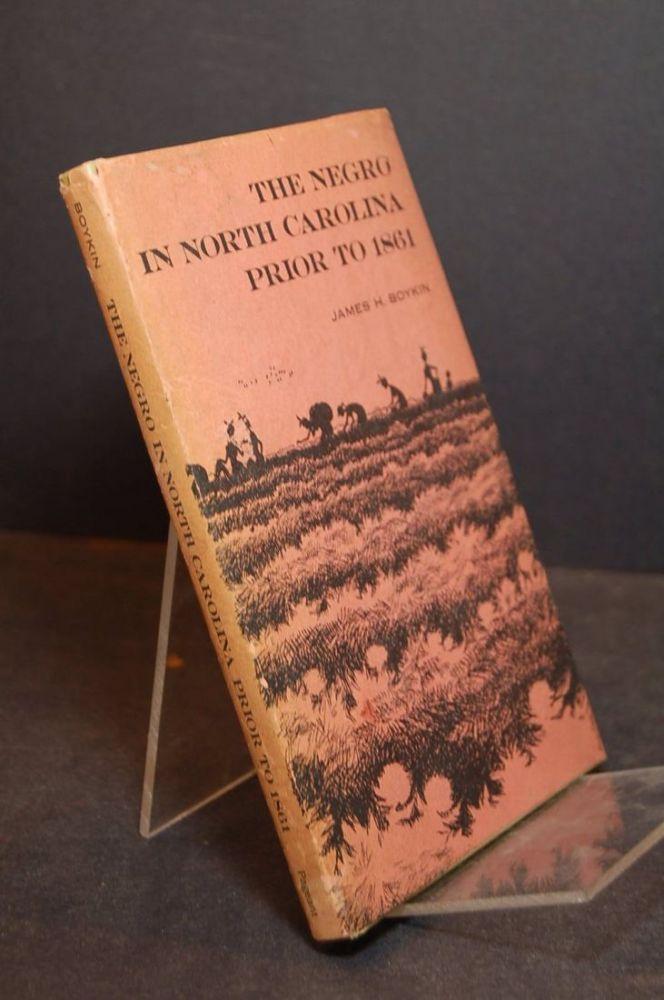
Boykin, James H. The Negro in North Carolina Prior to 1861. New York: Pageant Press, 1958.

Criticism:
At this point I cannot impress enough how important it is to follow the research trail back to the original primary documentation, for the apprenticeship bonds and Minutes of the Craven County Court of Pleas and Quarter Sessions reveals that there was more to the Carter apprenticeships than given here. . . and the sisters of William Carter were not apprenticed as coopers as were their brothers, but as spinsters. Also, it does not mention that four years later, the Carter siblings were removed from the Physioc household and placed in the households of Isaac Perkins, their maternal uncle, and to John Marchmont. Isaac Carter was then to be trained as a shoemaker. His brother William was apprenticed to be a blacksmith; and the girls continued as spinsters.

In Conclusion:
For this reason, and as proven by various other sources I have read, it is absolutely imperative to work with primary documentation. I wish the National Endowment for the Humanities would recognize this when determining the merits of independent scholarship. If authors rely heavily on second- and third-hand information, historical truth becomes a distortion at best, or a fabrication at its extreme. If we are to know how our ancestors lived within the context of time, location and society, we must endeavor to get to the heart of truth.


Friday, July 13, 2012

Diving Into. . .

File Box 1, File No. 1.2:
Watson, Alan D. African Americans in Early North Carolina: A Documentary History. Raleigh: Office of Archives and History, North Carolina Dept. of Cultural Resources, 2005.


Available at Amazon.com
The Contents page lists the following chapters:

Slavery and Slave Trade
Slaves: Property, Labor, and              Emancipation
Family
The Slave Code
Resistance to Slavery
Discipline and Punishment
Urban Slavery
Free African Americans

I also photocopied the Sources Cited.

When photocopying directly from book sources I always photocopy:
  1. the title page,
  2. the bibliographical information page,
  3. the table of contents, and
  4. pertinent parts of the index.
  5. When searching the index, I highlight the pages containing keywords that relate to my research; but then, I check to see if there is relevant contextual information before and after the keyword. Sometimes it may be only a paragraph or so before or after. . . other times it could be additional pages, or even a chapter en total.
  6. Then, I make a notation on the bottom left-hand corner of the title page with the name of the repository where I found the source, the catalog number, and any other notes. The notation on this source: suggested for purchase?
Four years after collecting this source information, 
I discovered that I had already checked most
of the bibliographical sources related to my research!

Additional Sources:

Boyd, William K., ed. William Byrd's Histories of the Dividing Line Betwixt Virginia and North Carolina. Raleigh: North Carolina Historical Commission, 1929.

Carroll, Grady L., ed. Francis Asbury in North Carolina: The North Carolina Portions of the Journal of Francis Asbury. Nashville, Tenn.: Parthenon Press, 1964.

Commissioners' Minutes, Town of New Bern. North Carolina State Archives, Office of Archives and History, Raleigh.

Craven County, Minutes of the Court of Pleas and Quarter Sessions. North Carolina State Archives, Office of Archives and History, Raleigh.

Hening, William Waller, ed. The Statutes at Large; Being a Collection of All the Laws of Virginia. 13 vols., 2d ed. Philadelphia: the editor, by Thomas Desilver, 1820-1823.


Thursday, July 12, 2012

Diving Into. . .

File Box: 1, File No. 1.1:
Franklin, John Hope. The Free Negro In North Carolina: 1790-1860. Chapel Hill: UNC Press, 1943.


Introduction:
Available at Amazon.com
In May of 2008 I applied for an National Endowment of the Humanities Independent Scholar Fellowship to research and write a prequel to this monumentous book, entitled: Migration and Settlement Patterns of Free Negroes in Colonial America, Part I: The Southern Colonies, 1728-1790. The problem, I was told, was that the scope was too large and that I concentrated on too many primary sources...I needed more secondary sources. They had me completely baffled on the sources issue; but, after a short period of grieving, I regrouped and continued the research from a different angle.

The years selected began with the year the Dividing Line between Virginia and North Carolina were established and the territory was opened for settlement and ended where John Hope Franklin began, but with emphasis on other aspects not covered by the author. It was to encompass sixty-two years and five states.

Presently, the historical narrative I am working on covers three generations of a family's life in Coastal North Carolina between the years 1854 to 1954. While the focus has tightened, the span of years has extended.

Selected Text:
The photocopies in this packet are from four chapters, as follows:
Chapter II: Growth of the Free Negro Population,
Chapter IV: The Free Negro in the Economic Life of North Carolina,
Chapter V: Social Life of the Free Negro, and
Chapter VII: Conclusions.

It's always interesting to review previously selected books. What caught my attention four years earlier differs from today's emphasis. Then the focus was migration patterns. Now I'm more concerned with specific points, i.e. education, apprenticeship, religion, the Free Negro Code, housing, diet and health issues.

Several quotes from the Conclusions sum up these concerns:
It was one thing to inherit or acquire freedom and quite another thing to maintain it. . . . Free Negroes in North Carolina were, moreover, a rural people. . . however, their living in the rural areas had the effect of making their presence less objectionable, since they were seldom in large numbers. . . . Had it not been for the system of apprenticing free Negro children to white masters for the purpose of training them to make a living, the economic influence of the free Negro would have been even less than it was. . . . As farmers, farm laborers, and common laborers, they were able to eke out a living if they could find an opportunity to ply their trade. . . . What literacy there was among the free Negroes came largely from the apprenticeship system. There were also religious sects, such as the Quakers, Methodists, and Presbyterians, who were engaged in the task of training free Negroes, but they touched only a very limited number (excerpted from pages 222-224).

One note of interest: At the end of the book is a section of Appendices. Appendix I is a table entitled, Free Negro Apprentices in 1860. Craven County, where our Carters and Georges lived, there were only 16 apprentices in the county.

New sources of interest: The John H. Bryan Papers: 1773-1860. Interesting observations of the free Negroes of New Bern, in the Archives of the North Carolina Historical Commission. And The John H. Bryan Papers: 1798-1860, in the Manuscript Collection in Duke University Library.

Friday, July 6, 2012

Diving Into Secondary Sources


Craven County in 1853
Sitting and staring at page after page of digital newspaper entries of a search of  <1853 "New Bern> which results in only two sources: The Fayetteville Observer and the New York Times, is getting me nowhere fast. Not much of interest appears in pages for the amount of time spent.

Pack Memorial Library, in
Modern Asheville,
by Troy Winterrowd
When we first moved to Asheville, NC in February 2007 I began an intensive dive into every known book and document available for Craven County and Eastern North Carolina at Pack Memorial Library. It was a sort of frenzied find-all-you-can-as-quick-as-you-can adventure in research. Sometimes the genealogist instinct tells us to absorb it all now because tomorrow is not promised. After several years of scouring the North Carolina Collection, my favorite local history librarian asked me if I hadn't read every book by now. Almost, I replied, almost. And so it was...

I started out taking handwritten notes in Composition notebooks and photocopying pages of books...making notations of ones for future purchase. Then, after the last Bush Tax Rebate, I purchased my first laptop computer and entered notes in MSWord 2007. (I haven't held that much money in my hand at one time since then when I handed it over to the salesman at BestBuy.)


The notebooks and photocopies were then filed away in clear, plastic file boxes, and labeled. The first of three boxes holds the following files: NC-Free Negroes, NC-Trades, Church History, Timber, NC-Civil War and NC-Physiocs. (Perhaps now might be a good time to print out those Word docs as well...)


Somewhere in all these records
must be the available data for 1853 Craven County.

I'll start here with a Bibliography of my sources and then report here on any information which might be of help in recreating the time period of the Carters' trek from North Harlowe to the Craven County Courthouse in New Bern in December 1853 and the life of an apprentice which followed.

Bibliography:
Box No. 1
File No. 1: NC-Free Negroes
  1. Franklin, John Hope. The Free Negro in North Carolina: 1790-1860. Chapel Hill: UNC Press, 1943.
  2. Watson, Alan D. African Americans in Early North Carolina: A Documentary History. Raleigh: Office of Archives and History, North Carolina Dept. of Cultural Resources, 2005.
  3. Farlow, Gale. "Black Craftsmen in North Carolina," in North Carolina Genealogical Society Journal, Feb. 1985: Bound Volume 11.
  4. Taylor, Rosser Howard. "The Free Negro in North Carolina," in The James Sprunt Historical Publications, Vol. 17, No. 1. Chapel Hill: UNC Press, 1920.
  5. Woodson, Carter G. Free Negro Owners of Slaves in the United States in 1830. Washington, D.C.: The Assoc. for the Study of Negro Life and History, 1924.
  6. Mabry, William Alexander. "Negro Suffrage and Fusion Rule in North Carolina," in The North Carolina Historical Review, Volume XII, Number 2, April 1935.
  7. Browning, James Blackwell. "The Free Negro in Ante-Bellum North Carolina," in The North Carolina Historical Review, Volume XV, Number 1, January 1938.
  8. Franklin, John Hope. "The Free Negro in the Economic Life of Ante-Bellum North Carolina, Part 1," in The North Carolina Historical Review, Volume XIX, Number 3, July 1942.
  9. Nelson, B.H. "Some Aspects of Negro Life in North Carolina During the Civil War," in The North Carolina Historical Review, Volume XXV, Number 2, April 1948.
  10. The Proposed Suffrage Amendment: The Platform and Resolutions of the People's Party. [Available online, 2 Jan 2008] http://docsouth.unc.edu/nc/populist/populist.html


Tuesday, October 11, 2011

From Bishop Hood to local ministers

In 1867, Bishop Joseph Jackson Clinton offered missionary Hood a position to stay in New Bern; however, he addressed his desire to move on to the eastern and western portions of North Carolina. His short three-year stay  was not what I had expected when I went into this research. He accepted a pastorate at Fayetteville, NC where he he was positioned closer to Raleigh, allowing him greater opportunity for political advancement.

So, after pinpointing his Craven County involvement to a period between 1864-1867, I turned my attention to Hood's sermons from that period.

Was there anything evident in his messages to the Church that would hint of his political and social aspirations for his people in the way that Dr. Martin Luther King, Jr. had presented?

While waiting for two books of Hood sermons to arrive via InterLibrary Loan (ILL), I turned my attention to the Census between 1850 and 1930. . .

Who were the men noted as ministers in Township 5? What were their affiliations? On what level of the family tree might they have made an impact? And what would tracing their family over time show about their careers? 

Sunday, July 17, 2011

Going Backward to Move Ahead: 6 steps toward a well-documented family history

For my birthday this year, one of the gifts I received was a T-shirt with the logo Family History Detective on the front. That says it all.

Among my favorite detectives are Sherlock Holmes, Charlie Chan, and Hercule Poirot. Each has a unique style for getting to the truth of a mystery; but they always  pursue the clues, and in the end expose the truth.

Being a genealogist is a bit like being a detective. We search for clues...make inquiries...check sources...and follow the trail back to the place where it all began.

If you're like me and you've been researching your family for some time, you've accumulated files and binders and notebooks galore! You may have worked on a particular aspect of your research in the early years, and now find that you must access and re-examine some of that information for a lead in your current explorations. Such was the case last night.

Back in 2005 I received four reels of microfilm from the Library of Virginia on Inter-Library Loan. The condition of the Virginia documents was much worse when they were microfilmed than those of Massachusetts. Parts of the pages had been torn or blotted out, and ink had faded in places. Parts of the document were very difficult to read. I recall completing the transcription, and I thought I had printed the document. . .
. . . but last night when I pulled the file box and notebooks 
containing my Virginia sources and notes, 
I could not find the Will, nor could I find the transcription!

It's been  six years since reading the Will of Ann Southey Littleton, and nearly four-and-a-half years since we relocated to Western North Carolina. It could be anywhere. At any rate, it seems that I will have to re-order the microfilm.

There are several things you can do to use 
all your existing clues to work back to the original sources, 
and avoid having to retrace your steps later.

  • When you find a clue that sets you on the path to solving your mystery, check the author's sources. On our first visit to Craven County, NC I had photocopied  the Carter, George and Cannady sections of Paul Heinegg's book, Free African Americans of Virginia, North Carolina and South Carolina and made notes on the sources he used. In this case, it appeared that he relied mainly on county records: apprentice indentures, county court minutes, and deeds.
  • Always look for a means to contact the author. The online version of this book included a note: "Send questions and comments to . . . ." Sometimes authors have their own website to promote their books, or their publisher or agent may have a page devoted to their client where they are willing to act as an intermediary for them. I have contacted authors by all these means, and for the most part they usually write back. On September 9, 2005, Paul Heinegg wrote, 
"I did that research when I was first starting about 20 years ago. At that time I used  Joseph Douglas Deal's PhD thesis,  Race and Class in Colonial Virginia: Indians, Englishmen and Africans on the Eastern Shore during the Seventeenth Century. Years later I went back and ordered the microfilms from the Library of Virginia. . . . "

  • If you're as lucky as I was to discover a source not mentioned previously, go directly to that source, and check it's sources. While I had learned of Deal's dissertation  in 2005, it wasn't until this year (2011) that I was able to locate a copy of the book for my own collection. While Paul was gracious enough to email me scans of the chapters on the Carter and George families, having the original source right in front of me provided critical analysis of the original texts found in Virginia county records. 

  • If you have access to Ancestry.com's public member trees . . . look for a well-sourced tree containing your ancestors and contact the owner of the tree. Sometimes, not only will you find new leads, you may learn of a rootsweb surname list that will widen your opportunity for clues. Make sure to print out or save to disk all emails pertaining to your research. Years later, if you need to retrace your steps, these are very valuable. From one member of the LITTLETON-L, I was informed that:
"CARTAR or Carter was a family name somewhere . . . ."
And another reports: 
"My family who are descendants of Littleton's carry a Carter middle name as a family name so lost in the past. My father carried the name as David Carter Wood." 

  • Keep following the trail until you come upon a primary source . . . one that was written by an eye-witness. In this case, it would be wills, deeds, and court minutes; but the greatest find would be a slave ledger, a ship's manifest, or a diary. 

  • At every step of the search, document--document--document. While researching my New England ancestors on microfilm, I had the foresight to keep each print in an archival sleeve, tagged with a label: 

While I am usually very careful in my documentation, I can at times neglect this important step. I hope this helps you to prevent the pit-fall which I have stumbled into. 

Saturday, July 2, 2011

"Re"- Sorting Saturday--Digging to expand on church history

When I first relocated from Southern New England to Western North Carolina, I spent every day I had off from work, and some nights after work when I got out early enough to take the bus into town, at Pack Memorial Library on Haywood Street in Asheville. I treated each visit as though my last was not too far ahead... I believe this was due to the previous six months when I had to prepare to relocate from Northampton, MA to Asheville, NC. My KING ancestors' information would remain in the North unless I could immerse myself in their records and bring them along with me.

And so I photocopied anything and everything that minutely corresponded to the history of Free Negroes in Craven County from the Colonial Period to the present. When I returned to the North Carolina Room one day, about three years into my research, the local history librarian said, "I thought you'd just about exhausted everything we had." Yes, I thought so too...but there's always some new connection...laws and Negro Codes and Jim Crow; transportation, railroads and boating; wars and battles; elections, voting and Census records; geography and geologic formations, land and platting; turpentine distillation, Craven Corn distillation and logging. . . finally religion and churches.

After pulling the boxes and sifting through the files, I was surprised to find that I had only one file labeled "Church History." This is what I discovered there:

  • "Black Religion In North Carolina From Colonial Times to 1900," in The Heritage of Blacks in North Carolina, Volume I, 1900, pp. 75-80.
  • "The AME Zion Church celebrates its bicentennial," by Lisa Jones Townsel; [online].<http://findarticles.com/p/articles/mi_m1077/is_n12_v51/ai_18736489/print> Available 1 June 2007, 3 pages.
  • "Historic African American Churches in Craven County, North Carolina: 1864-1947," National Register of Historic Places Multiple Property Documentation Form, prepared by M. Ruth Little, Ph.D.
  • The African Methodist Episcopal Zion Church, by William J. Walls. Charlotte, NC: A.M.E.Zion Publishing House, 1974.
  • Francis Asbury in North Carolina: The North Carolina Portions of The Journal of Francis Asbury. Nashville, TN: The Parthenon Press. 
  • History of Methodism in North Carolina, From 1772 To the Present Time [1905], by W. L. Grissom. Nashville, TN: Publishing House of the M. E. Church, South, 1905.
  • "Some Aspects of Negro Life in North Carolina During the Civil War," by B. H. Nelson, in The North Carolina Historical Review, pp. 143-167.
  • "The History of Piney Grove African Methodist Episcopal Zion Church, 1864 thru 1992," by Eilatan. [online]. <http://pineygroveamez.tripod.com/history.html> Available 1 June 2007.
  • A Guide to Researching the History of Religion in North Carolina. UNC University Libraries. [online]. <http://lib.unc.edu/ncc/ref/study/religion.html> Available 14 February 2010.
  • Several articles related to pulpwood, timber and lumber companies. . . How did they get in there?!
Combining these sources with the clues from emails I had recently collected, I have just enough information to barely construct a loose interpretation of what religious life was like in the isolated area of North Harlowe, Craven County, North Carolina from Colonial days through Reconstruction. 

So much information lies dormant in dusty rooms, shut off from the world because of budgetary cuts. My only hope is to connect with someone who has viewed the sources I have yet to seek and hope that they will be willing to share information. 

In the meantime, I believe I must go with what I have and begin the writing.

Tuesday, November 2, 2010

Isaac Carter: Determining the Identity of Same Name Rev War Soldiers, Part 3, UPDATED in 2024


Now that it has been proven that Isaac Carter of Craven County was not a Revolutionary War pensioner, does that mean he didn't serve as a soldier in the war?

According to “FORTITUDE AND FORBEARANCE” THE NORTH CAROLINA CONTINENTAL LINE IN THE REVOLUTIONARY WAR 1775-1783 (Babits & Howard, 2004),

“State troops and militia were not regarded as Continental service, even if the unit served as a part of a larger entity, such as the Southern army under Lincoln, Gates, or Greene. . . The official table of organization for a military force. . . made clear distinctions between Continental, state troops, and militia, even if they were serving together in a common cause.” (Preface)

With that knowledge, I turned to COLONIAL SOLDIERS OF THE SOUTH, 1732-1774, by Murtie June Clark (1983). This book contains a listing of all the states' militias. I began looking for the muster roll for companies originating in Craven County, North Carolina. Altogether, there were  thirteen (13) Field Officers and Captains of the Craven County, North Carolina Regiment of Militia:

1. Colonel Edward Griffith
2. Lieut. Colonel Daniel Shine
3. Major Hardy Bryan
4. Captain Lewis Bryan
5. Captain Thomas Graves
6. Captain Joseph Bryan
7. Captain John Shine
8. Captain Solomon Kew
9. Captain Abner Neal
10. Arthur Johnston
11. John Curruther
12. John Islar
13. Cassin Brinson

Within the Muster Roll of Captain Lewis Bryan’s Company, [Craven County, North Carolina,] October 25, 1754, I found Private Isaac Carter, Number 61. I thought it was strange that none of the other names on the muster roll were associated with people living along the South Side of the Neuse River. And then I found a notation, stating: “[District: James MacKilwain’s to Marils Run and upwards to ye county line between Craven and Johnson Counties]” (p. 704).

This was not where Isaac Carter's family lived, along the South Side of Neuse River and the west side of Clubfoot Creek.

I kept looking through the lists, trying to find another Isaac Carter listed with residents of his neighborhood. In the Muster Roll of Captain Abner Neale’s Company, Craven County, North Carolina, October 4, 1754, I found some familiar names associated with our Isaac Carter:

96. Private Abel Carter
97. Private Jacob Copes
98. Private Peter George
99. Private John Carter

A notation states: [District: between the head of Slocomb’s Creek to the head of Turnagain Bay].

Note, however, that October 4, 1754, was during the French and Indian War, not the Revolutionary War. Abel Carter was Isaac Carter's father (b. 1732, age 22), and this particular John Carter was his grandfather (b. 1714, age 40), and not his brother John (b. 1754.) Jacob Copes and Peter George had descendants who married into the Carter family. 

This was the correct family group, just a different generation in a different military era.

Even though the original information I had read in both Free African Americans of North Carolina and Virginia and The Black Experience in Revolutionary North Carolina proved to be incorrect, I came away from the investigation with four connections to the North Carolina State Militia, serving during the French and Indian War.

So, I have yet to prove Isaac Carter of North Harlowe's Revolutionary War Militia service.

Private Martin Black: Revolutionary War Pension File (S41441), Part 2

In March, I shared the transcription of  Private Martin Black's Revolutionary War Pension File , in which he described his service in mo...