Showing posts with label The Family History Writing Challenge. Show all posts

Saturday, April 6, 2013

How Family History Writing Forces Us to Dig DEEPER

February is Family History Writing Month
During the month of February, I went on hiatus from the Civil War Pension File of Isaac Carter in order to participate in the Family History Writing Challenge. My goal was quite ambitious, but I did succeed in setting up the framework of the family history memoir, and wrote a rough draft of the opening scenes.

The memoir focuses on a promise I had made to our Cousin Hattie Carter Becton in an interview, following the the 2009 George Family Reunion in North Harlowe, North Carolina. In case you missed the Challenge, you can find the posts here. The site was developed especially for writing challenges, beginning with this year's; so, you may want to go back to the first posts in the archive.

March was memoir reading, research & development month
Last month I continued working on the writing, but also began focusing on webinars and YouTube videos related to writing memoir. Two really great sites are National Association of Memoir Writers and Women's Memoirs blog. There are so many helpful resources available to assist memoir writers.

In between training sessions and archived videos from RootsTech, I pulled out my Legacy 7.5 training videos and started attaching scanned copies of primary documents and photos to my family tree in order to bring it up to professional standards.

April is the month to Dig DEEPER
As I was writing about my grandfather-in-law...the son of Isaac Carter...I wanted to refer back to a particular Census document that was not yet attached to my family tree. It wasn't too difficult to find located in a family surname binder by generation, but it would have been so much easier to just pull it up from the family tree. I could've gone to my Ancestry.com tree, but got involved looking up something else.

My mind went back to the family legend of how Hezekiah Carter killed a man over a woman. You can find the original post here. I had been told that there was more than one Carter family living in North Harlowe, and that John Henry Carter was from one of those other families.

But today, I decided to dig a little deeper and try to discover if there was any familial relationship between Hezekiah and John Henry Carter.

The Death Certificate
First I went back to John Carter's death certificate and abstracted the information contained there:

  1. A "colored" male, born June 10, 1888 in North Harlow
  2. Parents: James Fenner and Nancy Carter
  3. Married
  4. Occupation: Laborer
  5. Died on August 26, 1926, age 38
  6. Place of death: St.Luke's Hospital
  7. Cause of death: Homicide--gunshot wound, arm
  8. J.L. Hartsfield, coroner
  9. Buried Aug 27, 1926 in North Harlow
  10. Undertaker: Merritt Whitley & Sons, Newbern
  11. Informant: Josephine Carter, North Harlow
The last bit of information intrigued me. Josephine (Dove) Carter was Hezekiah's sister-in-law, the wife of William Henry Carter, who lived in the house next door. I began to wonder what her interest in the case, other than perhaps a witness, might have been such that she would be the informant on John Henry Carter's death certificate. Usually the informant is related to the deceased.

1900 Census
Next, I decided to search for his parents in the 1900 Census. I couldn't find a record of him living with his parents, or at least his mother. Instead, I found him in the household of Barbara Dove. She was a fifty-seven year old widow living with her nephews: Syvester (18), Ruffus (17), Lavy (10) and John H. (11), and her neice Alivia (7). The children were all Carters. 

Marriage Register Search
Now that a relationship is established between the Carters and the Doves, I wanted to see if Barbara was indeed a Carter. I discovered on the New Bern-Craven County Public Library's Marriage Register Search  that Barbara Carter married Jacob Dove on June 22, 1868. 

Family Tree Database
I searched my family tree database for a Barbara Carter and found one born abt. 1842 (NOTE: Barbara Carter was enumerated in the 1900 Census as being born in 1843, age 57), the daughter of William Carter and Nancy Moore.

The only problem with this information is that this Barbara Carter, to my present knowledge, did not have a sister named Nancy. 

1910 Census
In 1910, John (19) and his sister Olivia K. Carter (18) are both still living in the household of Barbara Dove. The other siblings have removed elsewhere.


After this, I was unable to find any further information on Barbara (Carter) Dove and her nephew, John Henry Carter, on Ancestry.com. Nor could I find any information on his mother, Nancy Carter. 

FamilySearch.org did not reveal any estate records which might prove any relationships in this case. 

Ask Family Researchers
My next step is to see if any cousins have any related information that might help reveal the relationship between John Henry Carter and Hezekiah Carter. 

If you might have any ideas on how to break through this BRICK WALL,
please leave your comments here.


Note: This article has been expanded and updated with new research. To read the current, comprehensive version and explore my latest projects, coaching, and storytelling services, please visit my official author platform at: debranewtoncarter.com.

Sunday, October 7, 2012

Drawing Upon Parallel Personal Memories

According to author/editor C. S. Lakin, your first paragraph needs three things to hook your readers into the story:


  1. Your protagonist (Isaac Carter),
  2. A catalyst or incident (the binding out of the four orphaned Carter children at the County Courthouse), and
  3. A hint of the protagonist's core need  (to keep his siblings together, to watch over and protect them).
I have researched how they might have journeyed from North Harlowe to New Bern...the route they may have taken to get to the Courthouse once arriving to the city...what the Courthouse may have looked like...

...and now, I need to recreate the emotional responses the protagonist and subordinate characters in this first scene may have had to the incident.
For this I rely on personal memories of a similar event. 

Going to the Courthouse
On November 28, 1990, nearly one month after our youngest child's death in a vehicle/pedestrian accident, my husband and I, the driver of the vehicle, our lawyers and a clerk magistrate sat down together at a closed session in Northampton District Court for a show-cause hearing.

The clerk magistrate announced that she had just come back from vacation and had not yet read the background of the case...and it looks like no one was injured. Almost in unison, everyone in the room cried out, Someone died!

We met for thirty minutes...one half hour...reviewed the circumstances, and resolved it among ourselves. Looking back, it seemed like more time than that had elapsed; and if I hadn't read it for myself in the newspaper I wouldn't have believed it.
It was an accident in the truest sense of the word, [the driver] said of Nichelle's death. It was a tragedy, he added, one that happened in three seconds, the time it took my truck to move eight feet. (Charges Ruled Out In Stroller Death, Union-News (Springfield, MA), Thursday, November 29, 1990, by Richard Bourie: Staff: Union-News.)
As we emerged from the small room upon a long, dark, narrow hall, a reporter approached us from the stairwell ahead. The questions he asked seemed trivial and intrusive. I recall a sense of annoyance that he would invade our privacy, not taking into account that we were in a public place. I answered tersely, then walked past him and descended the stairs.

Our two surviving children were not with us. I don't remember where they were...perhaps with their grandparents. That day's events preceding and following the hearing are as lost to traumatic forgetfulness as the memory of the hearing is forever etched in my mind. Even the memory of approaching the reporter is as walking through a haze, buffered by a valley of no recall.

Roughing out the courtroom scene...
And how must young Isaac Carter have felt...a fourteen-year-old young man, huddling his younger siblings about him, as they entered the courthouse. Master Temple instructed them to go with the Negro matron to the upper gallery and wait until their case was called.

The bell tolled in the cupola above, bidding the townspeople to come to court. It was a big day when the Quarter Session began. The Sheriff had rounded up a jury from among the planters and prominent men of the county, and onlookers and curiosity seekers pushed their way through the doors, hoping to get a seat in one of the plain, straight-backed benches of the gallery. . . .

I imagine Isaac felt an unnatural calm, like time was moving past him in a blur. The chatter of innumerable groups of people rose to a roar, yet muffled by a buffer of distortion. He saw people shoving, pushing, scurrying, but he felt detached from it.

And then the Sheriff entered:
Oyez, Oyez, Oyez. All manner of persons who have any thing to do before the Honorable the Judges of the Court of Common Pleas, Orphans' Court, and Court of Quarter Sessions, here holden this day, let them come forward and they shall be heard. (A Book of Forms for Practice in the Courts and for Conveyancing, Volume 2, p. 2102.)

Everyone stood as the Justice of the Peace entered and stepped up to the dias and took his seat on the tall bench, and then the people sat down.

A rail divided the general courtroom from the spectator's gallery, and beyond that sat two oval tables where the attorneys sat. Below the judge's bench were benches for the Sheriff and his deputies, and a smaller table where the clerk of court recorded the proceedings.

The gavel cracked three times, and the murmur of the crowd died down to complete silence. The Sheriff called the first case on the docket and people came forward and sat with the attorney at an oval table.

It seemed that case after case was called of one sort or another....

Turning a 2-D scene into 3-D
As I wrote the sketch for the opening of the courtroom scene, I noticed that while I could imagine the disjointed feeling of grief mixed with responsibility and living in the present, I was struggling with getting into the head of a fourteen-year-old boy.

I can see that after we move and get settled in, I'll be spending some time in my new office, surrounded with photos, the apprenticeship documents (which are currently packed away in boxes labeled, "Debra's Gen. Binders/Bedroom #2") and spending some quiet time imagining.


Note: This article has been expanded and updated with new research. To read the current, comprehensive version and explore my latest projects, coaching, and storytelling services, please visit my official author platform at: debranewtoncarter.com.


Thursday, September 27, 2012

From Character Development to Composite Likeness

When we last looked at character development, we discussed the soul wounds that our protagonist--young Isaac Carter--had experienced up till his fourteenth year of age. The succession of losses in his life most likely left him with fears of abandonment and of financial hardship, taking the form of a mask of self-reliance. All of this sounds so academic and detached.

Now is the time to determine how these theoretical fears and compensation affected the behavior, thoughts and attitudes of Isaac as he matured.

Gaining insights by looking backward
The first step to filling in gaps in descriptive character detail, such as answering the question: What did the fourteen year old Isaac look like? is to examine what you have and work backward.

STEP ONE: While we have no personal artifacts to guide us, we must first look at what we DO have. Below is a list I compiled of all of Isaac Carter's documentation to date:

  1. 1850 U.S. Census (9, living with parents & family)
  2. 1860 U.S. Census (19, apprenticed to William Temple)
  3. 1864 USCT Military Service Record
  4. 1867 County Marriage Record
  5. 1870 U.S. Census (29, married, farm laborer, 1 child)
  6. 1880 U.S. Census (39, married, field hand, 5 children)
  7. Civil War Pension File
  8. 1900 U.S. Census (59, married, pensioner, 8 children)
  9. 1910 U.S. Census (70, married, house painter, 1 child)
  10. 1918 Death Certificate

Of all these documents, the only ones which offer a physical description are the military service record (left) and the pension file.

This gives us the description of Isaac at ages 24, and then again at 48.


STEP TWO:
As I began to imagine a fourteen year old boy, I remembered our son at that age. He was very slight for his age due to the effects Chron's Disease. At his annual physical exam, the family physician would plot his height and weight on a growth chart.

With this in mind, I found the form needed at the CDC.

By plotting the height for Isaac at age 24 on this chart, I followed the corresponding growth curve downward to align with the vertical axis at 14 years. I concluded that Isaac would have been approximately 5 feet 5 inches tall, which is about the same height our son was at that age.

STEP THREE:
Next, I scanned photos for our son, my husband, my father-in-law and my father-in-law's uncle to see if I could morph them together to get an idea of what young Issac may have looked like. Below is the composite formed at MorphThing.


Now I have a more vivid image, which actually resembles our son with the lips and jawline of my husband's oldest brother. Heredity is an interesting thing! 

The next step will be to formulate a composite personality based on what I know of the past three generations of Carter males, and what I have heard through oral tradition about the previous two generations of Carters.


Thursday, September 13, 2012

Core Question #3: What personal lies hide YOUR character's vulnerability?

Lies, you say?
Courtesy of Linda Rowlands
Gravestone at Washburn Cemetery,
Scranton, Lackawanna, PA
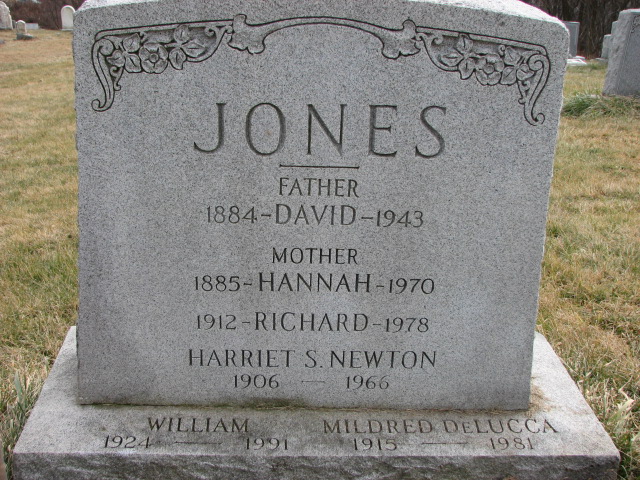
Yes, lies. We all believe them, whether we realize they are untruths or not. For instance, when I was five years old my grandmother was killed by a drunk driver as she stepped foot onto the curb. For years I had remembered part of a conversation I overheard shortly after her funeral regarding her grave marker.  She was the first female child of David and Hannah (Rowlands) Jones to die, and she was buried in the Jones family plot.

The grave marker was engraved with the surname JONES. My grandmother's  married name, however, was NEWTON. It seemed that it had been proposed that her name be engraved on a separate stone with the surname facing the opposite direction. That is what my mother and I had always believed had happened. In fact, I thought that I had seen such a stone when we went to the cemetery for my grand aunt Hannah (Jones) Holden's interment.

In fact, no such stone ever existed. It wasn't until some years later that a cousin connection through Ancestry.com led me to this photo of the grave marker which verified that my grandmother's name had actually been engraved at the bottom of the family gravestone: Harriet S. Newton, 1906-1966. (Now if I could only find out what the initial "S." represents.) I had no idea that this was, in fact, a lie that I had believed because I did not have access to the truth and had only overheard a passing conversation and built a perceived reality around it.

What incidents of Isaac Carter's early life wounded him and caused him to believe a lie?
Wounds which distort our perceptions of reality do not have to be caused by severe traumas. They can result from issues such as the lack of strong, lasting friendships...betrayals...rigid parents who instill negativity which erodes their confidence and cripples their ability to perform...or a host of other events that many of us might take for granted, but which scare the child early in life.

While it's obvious that his youngest brother's seizure disorder, the death of his parents, his grandfather's declining health, the separation of the family resulting in the four youngest children being apprenticed to Master William Temple each would have been enough in itself to wound young Isaac, there must have been other incidents common to children in general, as well those created by living within the regional, racial and economic boundaries of that era, that could have exposed an area of vulnerability.

It is impossible to know just how these soul wounds may have affected young Isaac as he matured, but it would not be unreasonable to think that he may have developed a fear of abandonment to some degree. Many times these children mature into adults who become the mediator, one who wards off conflict, and tend to take on multiple roles within the family. They may lose themselves in some sort of industry, be it work, a hobby or other interest which serves as a distraction. They are known as the one no one has to worry about.

If this were the case, then Isaac's false front would be the mask of self-reliance which would hide an intense fear of depending on others. Once a deep attachment is formed, i.e. friends, marriage and children, he would inwardly worry excessively that the relationship might end in illness and eventual death. It might also take the form of a fear of financial hardship should he become incapable to provide for his family due to illness or death.

Now that we've gotten to the core of our protagonist, the next step is to determine how these motivators shape the plot of our story....

Core Question #2: What is YOUR character's greatest fear?

Some life application of the 3 Core Questions
Recently I presented the three core questions for character development to a Teen Sunday School class and asked them to answer these questions about themselves:

  1. What is YOUR core need...your motivation in life...and what would you do if you could not attain it?
  2. What is YOUR greatest fear?
  3. What incidents in YOUR life have wounded you and caused you to believe a lie, or have shaded your perception of life events? 
These questions are a great tool for getting to the heart of our inner truth! I believe most people are caught up in a cycle of  Greek drama, weather comedy or tragedy, hiding their true selves to cover their vulnerability. Sometimes, however, by wearing a mask people begin to believe a lie about themselves or even about the people and world around them. 

Back to young Isaac Carter
I believe that the greatest fear is linked to the core need, and acts as a negative motivator in an individual's life. While Isaac's core need following the death of his parents was to watch over and protect his younger siblings and keep their family unit intact, it was broadened in adult life to protect and free his Negro brethren from a system of enslavement. 

His greatest fear was a negative motivator striving to produce a positive outcome...and that was...
...the fear of losing his family
and being alone in a hostile world...

The next step is to revisit Isaac's life events and apply the core need and greatest fear to them in order to determine the lie he came to believe about himself and the world in which he lived....


Note: This article has been expanded and updated with new research. To read the current, comprehensive version and explore my latest projects, coaching, and storytelling services, please visit my official author platform at: debranewtoncarter.com.


Tuesday, September 11, 2012

Core Question #1: What was young Isaac Carter's core need?

First off, let me give a big shout out to C. S. Lakin, whose series The Heart Of Your Story on her blog, Live Write Thrive, has been a great source of direction in this phase of planning for the writing of my family history memoir! You can find her posts about character development and other topics here.

Next, I want you to know that determining young Isaac Carter's answers to the 3 Core Questions has been much more difficult than I thought it would be. In fact, I'm still figuring it out...and for that reason I am focusing today on just the first question:


As I've contemplated the events of young Issac's life in late 1853, I've realized that he must have experienced a life shift which changed him down to the very core.

His parents were both deceased sometime prior to September 1853...
...his grandfather was very ill for at least a year...
...his family was being split in two, and

this middle child then found himself 
in the position of being the oldest of four children 
being bound out to a white landowner 
who had been a good friend of the Carter family.

I am beginning to see that his core need at this phase in his life would be to keep his siblings together, to watch over and protect them. 

If we were to just go back a few years to October 1850, we would find Isaac at home with his parents and all of six siblings. His life would have been much different that that of more recent generations of young adolescent African Americans. He may have shared some of the same dreams and desires as many boys have today...but during planting and harvest time, he would have been found working in the fields right alongside the rest of his family. He would not of had to make the adjustment between elementary school and middle school because he would not have attended school as there were yet no school for free Negroes in North Harlowe, North Carolina. 

But even this life would have weighed lighter on his shoulders than the burden of becoming the father-figure to his younger siblings. 

And what if he could not attain it? 
On October 24, 1861 Isaac became of age and was freed soon after. In July of 1863 his sister Nancy married at the age of twenty. Annanias would have been eighteen years of age, and Zach, fifteen. By June 1871, Nancy reported in her Freedman Bank Record that her only surviving siblings were Isaac and Mary. So, with no record of either brother following the 1860 Census, is it presumed that they most likely died between 1860 and 1871.  Annanias would have been between the ages of 14-25, and Zach between the ages of 12-23. It is difficult to tell when Annanias may have died; however, Zach was the sickly child. For that reason I tend to believe that he may have died first. 

It's hard to tell if young Isaac was able to attain his core need or not. Part of me would love to believe that he did; but, when seeing that by 1871 Nancy had lost both her husband and all three of her children to death, my heart sinks and I am persuaded that they probably died before they received their freedom.

In 1864 at the age of 25, Isaac joined the US Colored Troops in New Bern. If his brothers were alive they would have been ages 19 and 16 respectively. Something inside me believes that they were already deceased at that time, and that part of Isaac's desire to join the Union Army was to ensure the freedom of his people, and to make a better life for the next generation to come. And here his core need broadens not only to keep, watch over and protect his immediate family, but also for the generations to follow.


Note: This article has been expanded and updated with new research. To read the current, comprehensive version and explore my latest projects, coaching, and storytelling services, please visit my official author platform at: debranewtoncarter.com.


Friday, September 7, 2012

One Step BEFORE the 3 Core Questions...Birth Order

Yesterday I mentioned that I needed to answer the three core questions about each of my main characters before moving on. Well, when I sat down to work on it I realized there was something else I needed to consider.

Birth Order
My training in psychology always has me thinking in terms of family dynamic. What was the role each person played in the family? Back in the early 1980s when I studied Alfred Adler's theory of Birth Order and Personality, I began applying this information (along with the meaning and origin of names when selecting fictional characters' names) to my family groups to try to reconstruct a possible family dynamic.

In a brief examination of the birth order and ages of the children in Isaac Carter's household in 1853, I noticed an immediate pattern:

  1. Comfort (21)     }2 years between Comfort and William
  2. William (19)      }
  3. Mary Ann (15)  }4 years between William and Mary Ann
  4. ISAAC (14)        }1 year between Mary Ann and ISAAC
  5. Nancy (10)        }4 years between ISAAC and Nancy
  6. Annanias (8)    }2 years between Nancy and Annanias
  7. Zach (5)             }3 years between Annanias and Zach
Parents' Ages at Birth of Children
By maintaining the same numbering sequence as above for the children, we can construct a simple chart for the ages of the parents at each child's birth in order to gain some insight on how their ages might have contributed to the family dynamic:

M/A
F/A
16
27
18
29
22
33
25
36
28
39
30
41
33
44

By the time young Isaac was born, his mother was 25 years old with four children, ranging in ages newborn to seven years. 

Two Families in One
There are also two periods in the family's life: first, when the parents were both alive; and secondly, following their death and the children's separation from each other. Young Isaac's parents, Isaac and Rhoda Carter, died somewhere between October 8, 1850 and September 1853. Because of what we've learned about apprenticeship laws, we can safely assume that if his parents did not die together, his mother most likely would have died first...perhaps in childbirth, illness, or accident...followed by the father. It is estimated that it could take up to six months for an estate to be settled; however, no estate records for Isaac Carter have yet been discovered. 

Since William and Mary Ann were not yet of age when their parents died, I believe that they might have been living with another family member other than Kelsor & Sarah Braddock at the time of Kelsor's petition to the Craven County Court of Pleas and Quarter Sessions to place the younger children in the care of their family friend, William Temple. Even though they may have been living in the same residence as their sister, Comfort, who did not marry until July 1864, I do not believe that she received custody of them since she was a female, not gainfully employed to care for minor siblings; and also, no petition could be found bearing her name in regards to placement of the minor children.

So, while young Isaac was the middle child in his first family group, he became the functional oldest child in the second family group. At fourteen years of age, he then took on the responsibility of looking after his younger siblings...the youngest of whom was "taken to fits" (most likely some seizure disorder). 

How would a shift in functional birth order affect personality?
From the Adlerian Overview of Birth Order Characteristics chart (link above) you can see that middle children often feel sandwiched and may become even-tempered, a fighter for injustice, and may even find themselves operating as a mediator between two factions. Oldest children, on the other hand, often find themselves as the one to lead by example. The adult expectations upon them are usually high, and they often find themselves in roles of authority. When a child is a natural born first child, he often feels displaced by the birth of the second child and seeks the father's approval; however, in the case of a functional first child, this longing might not be as strong. Although, in a case like this where the father is deceased, the child might long for the father's presence to guide him, or to return him to his middle child state. In either case, the death of the father would most certainly have a marked affect on young Isaac.

What now?
By applying the natural tendencies of children's birth order, both natural born and functional, we can now assess changes in personality and behavior even into their adult life.

The next step might be to look at the affects of grief upon the children...and also that of separation of the younger siblings from the older. 

In the mean time...back to the 3 core questions...


Note: This article has been expanded and updated with new research. To read the current, comprehensive version and explore my latest projects, coaching, and storytelling services, please visit my official author platform at: debranewtoncarter.com.


Thursday, September 6, 2012

Who are the Characters in YOUR Family History?

Ancestors as Characters
Have you ever thought of your ancestors in terms of Characters in your family history? I have to admit that when I first started out on this journey to write a family history memoir, I first had to narrow down which story I wanted to tell, and once I decided that, I had to begin thinking of our ancestors in terms of characters within the book. After all, when you pick up a book, what is it that grabs your attention and entices you to continue reading? For me it's getting to meet the protagonist within the first couple pages and witness his/her reactions to whatever it is going on in the midst of the action.

Okay. So, we've established that our protagonist is going to be Isaac Carter.
Actually, our protagonist will change over time as we move from generation to generation. But at the onset, our principle player will be young Isaac (14).

Now, who else is in this story? The next set of people I looked at were his siblings who were also apprenticed. They would be:

  • Nancy Matilda Carter (10)
  • Annanias Carter (8)
  • Zach Carter (5). (He is referred to sometimes as Zacchaeus and at other times as Zachariah, hence the nickname, Zach.)
From there I began to think of who else would appear in the first scene. William Temple, their master, would be there. And depending on where I started the first scene, perhaps the boatman, Stephen Priestly, would be present. 

Once they arrived in New Bern, there would be those at the friend's home or rooming house where they lodged. 

At the Court of Pleas and Quarter Sessions, there would be the Clerk of Court (J.G. Stanly) and the Judge (Justice of the Peace, William Blackledge). And also would be the other persons appearing in court that day.

There would be mention of the children's family: Kelsor and Rhoda Braddock, their grandparents; and, their older siblings...and what about their deceased parents?

So, just from this initial bit of brainstorming, I've come up with the following cast of ancestral characters:
  1. Isaac Carter (14), protagonist
  2. Nancy Carter (10), sister
  3. Annanias Carter (8), brother
  4. Zach Carter (5), brother
  5. William Temple, master
  6. Stephen Priestly, boatman
  7. People at the lodging in Newbern
  8. Samuel W. Chadwick, Sheriff
  9. Judge William Blackledge, Justice of the Peace
  10. J. G. Stanly, Clerk of Court
  11. courtroom spectators
  12. Kelsor and Rhoda Braddock, grandparents
  13. Comfort Carter (21), sister
  14. William Carter (19), brother
  15. Mary Ann Carter (15), sister
  16. Isaac Carter, father (deceased)
  17. Rhoda (Braddock) Carter, mother (deceased)
  18. people in the Temple household
From here I must answer three question about each character:
What is his/her core need?
What is his/her greatest fear?
and
What is the character's inward and outward personae?

It might take some time before I complete the answers to these questions for the main characters in the book, but join me here next time when I share with you the answers to these questions for our protagonist, young Isaac Carter, and take a look at the next step in Writing the Family History Memoir.

Writing The Family History Memoir

What is a family history memoir?
There seems to be some discrepancy today of what genre our book might fall into: family history?  memoir? historical narrative? or some combination of the above....

Ahnentafel with modified register
 for Isaac Carter
For our purposes here we will agree that a family history is usually a narrative telling of one family, often including female collateral lines. It's scope often begins with the first immigrant in America and continues to the present; however, sometimes it may extend beyond the emigration story to life in the nation of origin. The narrative itself is a compilation of facts extracted from oral tradition and documentary sources, and may contain assumptions and conclusions drawn by the researcher/author. Many family histories conclude with the actual genealogy in an Ahnentafel chart. Here you'll see the first page of our Isaac Carter's ahnentafel with a modified register, which means that the report also includes an index for each child's lineage. An example of an exhaustive family history which I own is the NEWTON GENEALOGY: Being a record of the descendants of RICHARD NEWTON of Sudbury and Marlborough, Massachusetts, 1638, compiled by Ermina Newton Lenoard (1915).

Memoir is usually thought of in terms of a prominent person's reflections on their past, or perhaps of their child's reflection of their famous parent or grandparent's past leading up to their own self-discovery. An example of this genre is found in one of my favorite reads from last year, Missing Lucile: Memories of the Grandmother I Never Knew, by Suzanne Berne (2010).

Family history memoir refers to a descendant researcher's shared discovery of their family history and includes insights and conclusions drawn along the way. It is a personal journey shared with the reader. Most books in this genre limit the scope to just a few generations of interest, usually the author's parents, grandparents and sometimes even great grandparents. Oh Beautiful: An American Family in the 20th Century, by John Paul Godges (2010), is a daring example of a family history memoir which I enjoyed reading this past year.

The historical narrative attempts to show the reader how they lived by placing our ancestors within the context of place, period and society. 1861: The Civil War Awakening, by Adam Goodheart (2011), is a wonderful analysis of the start of the Civil War which transports the reader to the scenes of events and to the thoughts and actions of their prominent players.

Where do I begin?
This book takes place in eastern North Carolina and extends from the antebellum period to the time of the great migration. I will be writing about three generations of my husband's paternal family, beginning with his great grandfather, Isaac Carter and ending with my husband's father. 

I hope you'll stop back in days to come as I share with you the journey of Writing The Family History Memoir.

Tuesday, January 31, 2012

Preparing for Day 1 of The Family History Writing Challenge

Tomorrow is the BIG DAY . . . the first day of The Family History Writing Challenge. The challenge is to write the first draft of my family history book in 29 days.

29 DAYS! What I have I gotten myself into?!?!?

It's not really all that bad! Our writing guide, Lynn Palermo of The Armchair Genealogist, is coaching us step-by-step, to set realistic goals. Assignments are shared in a safe online forum where we support our fellow family history writers.

So far I have:
  1. narrowed the scope,
  2. outlined the book, and
  3. and defined the plot.
Now . . . one more challenge before the big day . . .

organizing my research!

I wondered were those prints of microfilmed obituaries from Surry County, NC were! They were from an October 2010 research trip, and found just in time for a return trip next month.

And the copies from a book which included the history of the synagogue my 2nd Great Grandfather David Silverman  co-founded! It's amazing what you'll find when locating past research materials! 

I've prepared a file box with topic folders for each phase of the book. Now, to get them filled with the information I'll be needing right at my finger tips . . . .


Private Martin Black: Revolutionary War Pension File (S41441), Part 2

In March, I shared the transcription of  Private Martin Black's Revolutionary War Pension File , in which he described his service in mo...