Thursday, September 13, 2012

Core Question #3: What personal lies hide YOUR character's vulnerability?

Lies, you say?
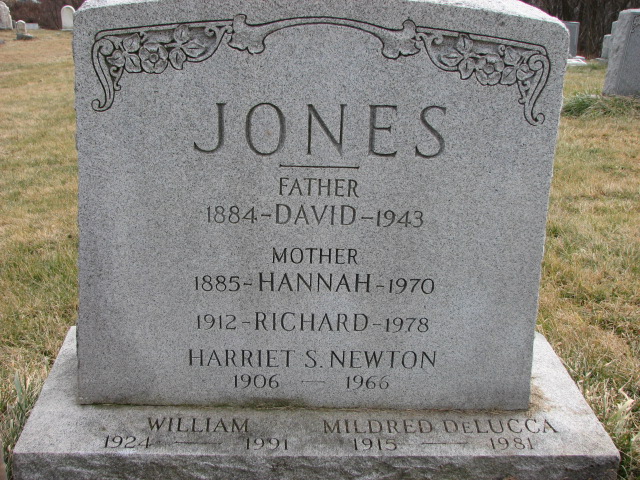
Courtesy of Linda Rowlands
Gravestone at Washburn Cemetery,
Scranton, Lackawanna, PA
Yes, lies. We all believe them, whether we realize they are untruths or not. For instance, when I was five years old my grandmother was killed by a drunk driver as she stepped foot onto the curb. For years I had remembered part of a conversation I overheard shortly after her funeral regarding her grave marker.  She was the first female child of David and Hannah (Rowlands) Jones to die, and she was buried in the Jones family plot.

The grave marker was engraved with the surname JONES. My grandmother's  married name, however, was NEWTON. It seemed that it had been proposed that her name be engraved on a separate stone with the surname facing the opposite direction. That is what my mother and I had always believed had happened. In fact, I thought that I had seen such a stone when we went to the cemetery for my grand aunt Hannah (Jones) Holden's interment.

In fact, no such stone ever existed. It wasn't until some years later that a cousin connection through Ancestry.com led me to this photo of the grave marker which verified that my grandmother's name had actually been engraved at the bottom of the family gravestone: Harriet S. Newton, 1906-1966. (Now if I could only find out what the initial "S." represents.) I had no idea that this was, in fact, a lie that I had believed because I did not have access to the truth and had only overheard a passing conversation and built a perceived reality around it.

What incidents of Isaac Carter's early life wounded him and caused him to believe a lie?
Wounds which distort our perceptions of reality do not have to be caused by severe traumas. They can result from issues such as the lack of strong, lasting friendships...betrayals...rigid parents who instill negativity which erodes their confidence and cripples their ability to perform...or a host of other events that many of us might take for granted, but which scare the child early in life.

While it's obvious that his youngest brother's seizure disorder, the death of his parents, his grandfather's declining health, the separation of the family resulting in the four youngest children being apprenticed to Master William Temple each would have been enough in itself to wound young Isaac, there must have been other incidents common to children in general, as well those created by living within the regional, racial and economic boundaries of that era, that could have exposed an area of vulnerability.

It is impossible to know just how these soul wounds may have affected young Isaac as he matured, but it would not be unreasonable to think that he may have developed a fear of abandonment to some degree. Many times these children mature into adults who become the mediator, one who wards off conflict, and tend to take on multiple roles within the family. They may lose themselves in some sort of industry, be it work, a hobby or other interest which serves as a distraction. They are known as the one no one has to worry about.

If this were the case, then Isaac's false front would be the mask of self-reliance which would hide an intense fear of depending on others. Once a deep attachment is formed, i.e. friends, marriage and children, he would inwardly worry excessively that the relationship might end in illness and eventual death. It might also take the form of a fear of financial hardship should he become incapable to provide for his family due to illness or death.

Now that we've gotten to the core of our protagonist, the next step is to determine how these motivators shape the plot of our story....

Core Question #2: What is YOUR character's greatest fear?

Some life application of the 3 Core Questions
Recently I presented the three core questions for character development to a Teen Sunday School class and asked them to answer these questions about themselves:

  1. What is YOUR core need...your motivation in life...and what would you do if you could not attain it?
  2. What is YOUR greatest fear?
  3. What incidents in YOUR life have wounded you and caused you to believe a lie, or have shaded your perception of life events? 
These questions are a great tool for getting to the heart of our inner truth! I believe most people are caught up in a cycle of  Greek drama, weather comedy or tragedy, hiding their true selves to cover their vulnerability. Sometimes, however, by wearing a mask people begin to believe a lie about themselves or even about the people and world around them. 

Back to young Isaac Carter
I believe that the greatest fear is linked to the core need, and acts as a negative motivator in an individual's life. While Isaac's core need following the death of his parents was to watch over and protect his younger siblings and keep their family unit intact, it was broadened in adult life to protect and free his Negro brethren from a system of enslavement. 

His greatest fear was a negative motivator striving to produce a positive outcome...and that was...
...the fear of losing his family
and being alone in a hostile world...

The next step is to revisit Isaac's life events and apply the core need and greatest fear to them in order to determine the lie he came to believe about himself and the world in which he lived....


Note: This article has been expanded and updated with new research. To read the current, comprehensive version and explore my latest projects, coaching, and storytelling services, please visit my official author platform at: debranewtoncarter.com.


Tuesday, September 11, 2012

Core Question #1: What was young Isaac Carter's core need?

First off, let me give a big shout out to C. S. Lakin, whose series The Heart Of Your Story on her blog, Live Write Thrive, has been a great source of direction in this phase of planning for the writing of my family history memoir! You can find her posts about character development and other topics here.

Next, I want you to know that determining young Isaac Carter's answers to the 3 Core Questions has been much more difficult than I thought it would be. In fact, I'm still figuring it out...and for that reason I am focusing today on just the first question:


As I've contemplated the events of young Issac's life in late 1853, I've realized that he must have experienced a life shift which changed him down to the very core.

His parents were both deceased sometime prior to September 1853...
...his grandfather was very ill for at least a year...
...his family was being split in two, and

this middle child then found himself 
in the position of being the oldest of four children 
being bound out to a white landowner 
who had been a good friend of the Carter family.

I am beginning to see that his core need at this phase in his life would be to keep his siblings together, to watch over and protect them. 

If we were to just go back a few years to October 1850, we would find Isaac at home with his parents and all of six siblings. His life would have been much different that that of more recent generations of young adolescent African Americans. He may have shared some of the same dreams and desires as many boys have today...but during planting and harvest time, he would have been found working in the fields right alongside the rest of his family. He would not of had to make the adjustment between elementary school and middle school because he would not have attended school as there were yet no school for free Negroes in North Harlowe, North Carolina. 

But even this life would have weighed lighter on his shoulders than the burden of becoming the father-figure to his younger siblings. 

And what if he could not attain it? 
On October 24, 1861 Isaac became of age and was freed soon after. In July of 1863 his sister Nancy married at the age of twenty. Annanias would have been eighteen years of age, and Zach, fifteen. By June 1871, Nancy reported in her Freedman Bank Record that her only surviving siblings were Isaac and Mary. So, with no record of either brother following the 1860 Census, is it presumed that they most likely died between 1860 and 1871.  Annanias would have been between the ages of 14-25, and Zach between the ages of 12-23. It is difficult to tell when Annanias may have died; however, Zach was the sickly child. For that reason I tend to believe that he may have died first. 

It's hard to tell if young Isaac was able to attain his core need or not. Part of me would love to believe that he did; but, when seeing that by 1871 Nancy had lost both her husband and all three of her children to death, my heart sinks and I am persuaded that they probably died before they received their freedom.

In 1864 at the age of 25, Isaac joined the US Colored Troops in New Bern. If his brothers were alive they would have been ages 19 and 16 respectively. Something inside me believes that they were already deceased at that time, and that part of Isaac's desire to join the Union Army was to ensure the freedom of his people, and to make a better life for the next generation to come. And here his core need broadens not only to keep, watch over and protect his immediate family, but also for the generations to follow.


Note: This article has been expanded and updated with new research. To read the current, comprehensive version and explore my latest projects, coaching, and storytelling services, please visit my official author platform at: debranewtoncarter.com.


Private Martin Black: Revolutionary War Pension File (S41441), Part 2

In March, I shared the transcription of  Private Martin Black's Revolutionary War Pension File , in which he described his service in mo...