Showing posts sorted by relevance for query Harlowe Patriots. Sort by date Show all posts

Thursday, March 14, 2024

The Forgotten Patriots Project at SOFAFEA.org

It's been years since I've written in this blog. So much in my life has changed since I researched for the North Carolina Society Sons of the American Revolution for the Forgotten Patriots Project. In the past, I wrote about 

  • the Revolutionary War Pension Files, 
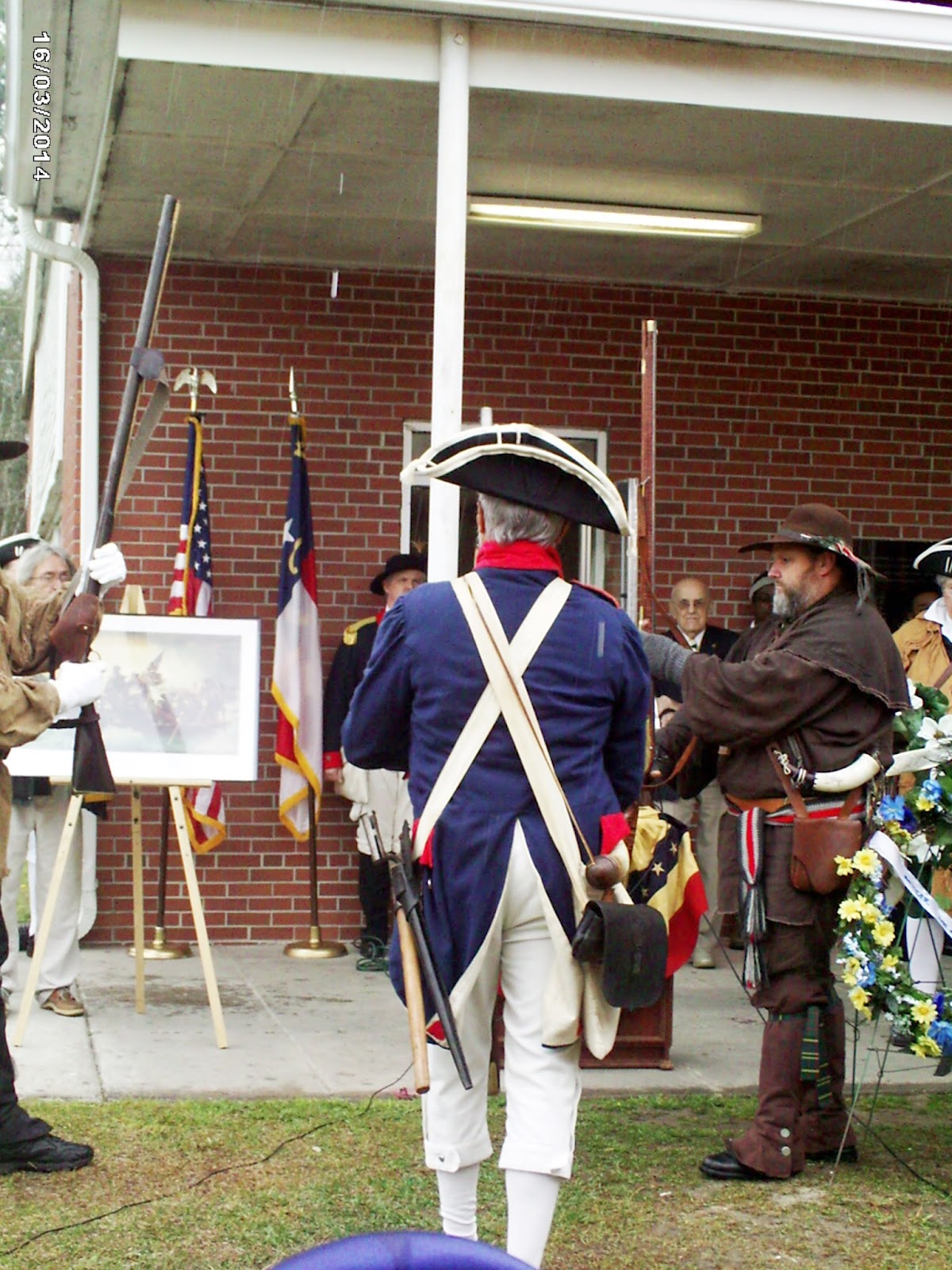
  • the SAR Grave Memorial Ceremony honoring the fourteen free Patriots of Color from Harlowe, Craven County, North Carolina who fought in the American Revolution (March 16, 2014), and
  • the Chartering of the only SAR Chapter named for a Patriot of Color, the Patriot Isaac Carter Chapter, named for my late husband Cedric C. Carter 's 3rd great-grandfather (September 3, 2016).

Photo Courtesy of Regina Yvette Carter Garcia, 2016
Cedric C. Carter pictured 5th from the Right

In August 2023, my brother-in-law, H. David Carter emailed me about an opportunity to continue my work on the Harlowe Patriots. The Society of First African Families of English America took the mantle of the Forgotten Patriots Project and is applying a multi-faceted approach. Since September 2023, I've been actively researching and writing about the details of the Harlowe Patriots' service by focusing on their regiments' movements in a series of engagements through three theaters of war. This has proved to be an enlightening challenge!

We are discovering new things about the trials our ancestors endured as we focus our research on the commanding generals, colonels, and captains of the soldiers' regiments found in written accounts of the battle history. Our sources go beyond the Survivor and Widow's Pensions, service records, and muster rolls, now including letters, diaries, state records, and military and local histories. Some of the things we thought we knew already have been proven flawed, and we are correcting that through a series of books we will be publishing. 

I am honored to be collaborating with about fifty authors and scholars on this project and will use this blog to help sort out some of the research questions I address as I work toward our first big deadline of March 31, 2024.

Thursday, March 20, 2014

Honoring our Ancestors: Free Black Patriots of the Revolutionary War

When I was first contacted last October to assist in some research for a member of the DAR who was looking for the burial ground of her ancestor, Isaac Carter, I had no idea it would lead to such a wonderful tribute--with full honors--to our free black ancestors of Craven County, North Carolina.

Nor would I have guessed that I would be meeting together with Ms. Maria William Cole, National Vice Chairman Insignia, of the National Society Daughters of the American Revolution, and a host of other dignitaries, from the highest officials of the SAR to state and local political and community service leaders, to pay tribute to these patriots.

The turnout exceeded my expectation when this event proceeded on a cold and rainy Sunday afternoon, with close to a hundred and fifty people or more, seated on folding chairs under three canopy tents.

The microphone cable lay along the wet grass and soon died out, and we, the speakers, were asked to use our "mother's voices" to make our presentations heard. Usually I record and transcribe the speeches at events such as this, but I had to forego it on this occasion. So, it is from memory that I share with you today the events of this past Sunday afternoon.

Perhaps the most memorable of all the speakers for me was Marion T. Lane, Ed.D., Commander in Chief, Society of the Descendants of Washington's Army at Valley Forge, and descendant of free black patriot, Martin Black, Private, Second North Carolina Regiment. Educator and author, she illustrated her message with descriptive cues which left one imagining how the patriotic free men of color had enlisted for the duration of the war, unlike the average white patriot, who had enlisted for only an average of nine months.

She depicted five northern regiments of free black patriots, including sailors, cavalrymen, and foot soldiers...fighting on the Continental Line and in the states militias. And then there were the free blacks of North Carolina. Their regiments were not segregated. Whites and blacks fought side-by-side for the freedom of a Nation, and of an oppressed people.


My presentation followed immediately after Dr. Lane's.
I am honored to be here on behalf of my husband, Cedric Carter, who is a descendant of seven of the fourteen free Black patriots we honor here today. 
1. Isaac Carter, his 3rd great grandfather,
2. Joshua Carter, his 3rd great-granduncle,
3. John Carter, his 3rd great-granduncle,
4. George Perkins, his 4th great-grandfather,
5. Isaac Perkins, his 3rd great-granduncle,
6. William Dove, his 1st cousin four times removed, and

7. Martin Black, his 4th great-granduncle.

When we speak to our cousins and friends here in North Harlowe about our free black ancestor who served their country so gallantly, their minds turn to the Civil War; but, the Carter family has a rich history! 
The Carters were not freed slaves who enlisted for service. No, they had been free since 1684! There have been several studies and books dedicated to the Carters and the Georges, and they have a rich history... a history of freedom... of land owners who worked together with their white neighbors to build this community of North Harlowe. 
And even before these patriots served, the Carters' father, Abel Carter, and their Uncle Isaac Carter, had served in the North Carolina State Militia as early as 1754 [French and Indian War]. 
When our children grew up and attended school in Massachusetts, they were taught about the 54th Regiment Massachusetts Volunteer Infantry... and they were taught about the freed slaves and contraband who joined the Union forces during the Civil War... but they were never taught about the free blacks of North Carolina who volunteered to fight in the War of Independence... the American Revolution.
I am honored to be here today, and urge you to tell your children of the free black patriots of Craven County who dedicated their lives to independence for all Americans, black and white.
As I spoke of the years of freedom our ancestor had enjoyed nearly two hundred years before the outbreak of the Civil War, I could see the smiles of pride among family, and the nods of agreement among researchers, historians and dignitaries.

Following the Retirement of the Colors, several members of the SAR approached me with hand shakes and warm regards of thanks for my participation.
"Without you," said Guy Higgins, the SAR genealogist  who had originally contacted me about the Forgotten Patriots project, "none of this would be happening today. Thank you."
Gary O. Green, whom I had assisted in identifying relationships among those buried in the George Family Cemetery, also gave me kind words of appreciation.

And lastly, I was surprised to be awarded a pin representing the SAR Outstanding Citizenship Award. I knew then that my departed 1st cousin once removed, Ralph Allen Cangson, former President of the Orange County Chapter of the California Sons of the American Revolution, would have been proud that I had continued in his footsteps.

As a family historian and researcher, I learned several things throughout this five-month project, but none more important than the humbling recognition that sometimes our family ties can be just as, if not more valuable, than what we know and can share about our family history. In all, it takes everyone working together... reenactors... researchers... family historians... and the multitude of cousins still on the home place... to accomplish an act of honor which will be represented in the community long after the speeches are over.


Maria Williams Cole,
National Vice Chairman Insignia
National Society DAR


Updated September 15, 2025

Saturday, April 6, 2024

Private Martin Black: Revolutionary War Pension File (S41441), Part 2

In March, I shared the transcription of Private Martin Black's Revolutionary War Pension File, in which he described his service in more detail than I've seen for any of the other Harlowe Patriots. Now it's time to go back and vet his claims, even though they were certified by William Hill, Secretary of State. Some areas need further research to understand troop movements--especially in the Northern and Mid-Atlantic Theaters during the Philadelphia Campaign, leading into preparations for being transferred to the Southern Department.

This will also assist with documenting Private Isaac Perkins' service record, and possibly another Harlowe Patriot who served in the 2nd North Carolina Regiment, but in a different company.

Private Black made the following claims in his Declaration:

1.    Georgetown--smallpox vaccination

2.    Valley Forge--Winter camp

3.    The Battle of Monmouth (June 28, 1778)

4.    The Storming of Stony Point (July 16, 1779)

5.    The Capture of West Point 

6.    Assembling at Albany

7.    Siege of Charleston (March 29 - May 12, 1780)

8.    POW, escape on 7th day (poss. May 19, 1780)

9.    Re-enlistment--Evacuation of Charleston

Since I've found substantial documentation for the first four claims, I will set that aside and focus on activities in the Northern Theater: The Capture of West Point and Albany, and return to the others later. 

Sir Henry Clinton's Hudson River Campaign

French map: Plan of Forts and 
Batteries, West Point, 1780
According to Hugh Rankin, "Washington's greatest fear had been a strong move against West Point." As early as December 2, 1777, the Commander-in-Chief wrote to Major General Israel Putman, "The importance of the North River in the present contest and the necessity of defending it . . . are so well understood . . . .that it runs through a whole State; That it is the only passage by which the Enemy from New York or any part of our Coast, can ever hope to Cooperate with an Army that may come from Canada; that the possession of it is indispensably essential to preserve the Communication between the Eastern, Middle and Southern States . . . that upon its security, in a great measure, depend our chief supplies of Flour for the subsistence of such Forces. . . . Sieze the present opportunity and employ your whole force and all the means in your power for erecting and completing, as far as it shall be possible, such works and obstructions as may be necessary to defend and secure the River against any future attempts of the Enemy."[1]

On June 23, 1779 Major General Alexander McDougall was transferred to the command of the West Point garrison consisting of Larned's, Patterson's, and the Carolina Brigades. The troops on the east side of the river were assigned to Major General William Heath. 

Who were Larned and Patterson?

On February 7, 1778, Brigadier General Ebenezer Learned wrote to the Commander-in-Chief, "...am very unhappy I have the Misfortune of Indisposition that I am unable Immediately to take the Field myself." The enclosures mentioned in the letter were a certification of his condition by Surgeon Jonathan King, dated January 25th, a certificate from Surgeon James Freeland, dated January 27th, and General Gates' permission "to be absent from the Army until he thinks himself to be perfectly cured," allowing him to leave his troops as Albany. The consensus was that one more winter campaign would endanger his life. [2]

In May 1781 Brigadier General John Paterson was commander of the 2nd Massachusetts Brigade operating around West Point, and "On Wednesday, September 19, 1781, Paterson's Brigade moved on to West Point and all his detachments joined the respective regiments they belonged to."[3][4]

Apparently General Learned returned to service following the winter of 1778-1779, because as shown above, he and his men were at the West Point garrison with General Paterson's and the Carolina Brigade in June 1779.

Which regiments made up the Carolina Brigade?

In a letter dated June 1, 1779, Major General Alexander McDougall informed George Washington that "The Brigades mentioned to you in a former Letter are at west Point, Pattens & Clarks were ordered to fall back into West Point. The first is arrived. I am in hopes this force with the aid of the ulster County militia will defend the works to the last extremity." Colonel John Patten commanded the 2nd North Carolina Regiment, and Colonel Thomas Clark commanded the 1st North Carolina Regiment--combined, they made the Carolina Brigade. The former letter McDougall referred to, written on May 25th, spoke of Paterson's being sent to West Point, while Nexon's "on this side of Kings-Ferry," or Stony Point. [5] 

John Patten's 2nd North  Carolina Regiment

Now that we've established from original sources that the 2nd North Carolina was at West Point's garrison in May and June of 1779, we can now focus on searching for a skirmish that occurred on May 16, 1779. 

But here is also where much frustration set in as I examined the references Hugh Rankin recorded for his description of the May 16th skirmish, in which Clark's North Carolina Regiments participated. 

Rankin's version of the account follows. "[Sir Henry] Clinton kept the Americans along the Hudson off balance by several raids on river towns." And this is where the Commander-in-Chief's fears about possibly a "strong move against West Point" come into play. "Clark had been stationed in such a position that he was able to furnish support to several stations. Smaller detachments were scattered throughout the area to block communications with New York." But on this particular day, "two columns of five hundred redcoats each crossed the river [italics mine] and attempted to close in on Clark." Some deserters from Clinton's camp had straggled in and from them, Clark learned that his troops were their objective and that the British had planned "to converge on him at Paramus Church."[6]

"The river." What river? They were stationed at West Point along the Hudson River, but these men were in the field. So, what river? And where did the British cross? The key to this question was the original letter from Colonel Thomas Clark to George Washington, dated 17 May 1779.[7]

Map of Historic New Bridge Landing
Courtesy of Bergen County Historical Society

The New Bridge

Writing from Paramus, New Jersey, Col. Clark says that his scouts were attacked by "a large body of the enemy" at the New Bridge. ". . . 500 had crossed the Bridge and taken possession of the hights [sic] on this side the river and a considerable body remaining on the other side. . . . my Light Infantry and a Captains Command joined a few Militia as near them as possible to prevent pillaging--about 5 oClock in the afternoon, another express from my Scout at Tapan informed me that 500 men were on their march for this place . . . 7 miles from this they changed their rout [sic] and march'd to the New Bridge . . . the enemy recross'd about 10 yesterday evening taking up the Bridge after them. . . . By two deserters . . . the enemy's force consisted of the 63, 64 Regmts Buskerks Corps, 100 Fergusons riflemen, the refugees, Some Grenadiers & Light Infantry making 1000 to march by way of Hackensack Bridge, and 500 others to Land at Closter dock and proceed thro Tapan to Paramus Church where they were to make a junction by day Light. . . ."[8]

This changes the whole complexion of the skirmish. We now have a landmark. The New Bridge crossed the Hackensack River at what is now known as River Edge Township, New Jersey - 40 miles from West Point.

In the image above, there is a text box, "HISTORIC NEW BRIDGE LANDING"  to the right of the bridge, and another text box, "British troops drive the American rear guard..." to the left of the bridge, which spans the Hackensack River.


Courtesy of Edward Konsevick
The map to the left gives a better idea of how the waterways are connected. The Hudson and Hackensack Rivers flow southward, running parallel to each other, with the Hudson emptying into Upper New York Bay, and the Hackensack emptying into Newark Bay, which connects north of Staten Island. It appears that the New Bridge --also called the Hackensack Bridge by some Continental officers -- would be in the 
NJMC DISTRICT, just below the first letter "T" as the river turns southwest, The original New Bridge, dubbed "The Bridge That Saved a Nation," was an oak draw-bridge, spanning the narrows of the Hackensack River in what is now known as the township of River Edge, New Jersey, some forty miles south of West Point. When Colonel Thomas Clark says, "they recross'd . . . taking up the Bridge after them," he meant that after they crossed the river, they pulled up the draw-bridge so no one could follow from the opposite side.[9]

Closter Dock, Tapan, and Paramus Church

In what is now known as the borough of Alpine, New Jersey, the Closter Dock Road led from the town of Closter "up over the cliffs of the Palisades down to" the Lower Closter Dock. About six miles north of Fort Lee and sometimes called “Huyler's Landing" or "the New Dock" in Revolutionary War correspondence, it was a busy commercial boat and ferry landing, making it an important route for American and British forces.[10][11]

The original building of Old Paramus Reformed Church was built in 1735 at Ridgewood, New Jersey - 6.8 miles from Paramus, 39 miles from West Point. This is where the British planned to converge on Clark's troops. But where were they when they received this information?

Thoughts to Consider

Researching microhistory should always leave us with more questions. As we follow the trail of sources left by scholars, we can gain new insights. It's important, however, to always try to maintain your focus for each project as an inquisitive mind can take you down the road of Many Tangents. Writing a blog allows me to gather and analyze data and to formulate new research questions. However, when I'm writing for a book, I must often rein myself in to the scope and purpose of the information needed. As I begin to share more about where this research is taking me, I will present some of the challenges that I face when working on both collaborative and individual projects.

Updated September 4, 2025


Tuesday, March 19, 2024

Isaac Carter: Distinguishing the Identity of Same Name Rev War Soldiers, Part 7

 I feel like the last post took us on a circuitous route that has left me a little breathless. Boiling it down, my next move is to look at commanding officers, locations, and dates:
  1. Major John Tillman, Craven County Regiment of Militia,
  2. Captain Silas Stevenson, 10th North Carolina Regiment,
  3. Captain Clement Hall, 2nd North Carolina Regiment, and
  4. Captain Robert Fenner, 2nd North Carolina Regiment.
I decided to work on them in this order because of the timeline of the regiments coming out of Craven County, North Carolina. For that, we'll have to look at a bit of North Carolina military history.

NC Patriots 1775-1783, Their Own Words


One of the best sources for regimental history is this book series by J.D. Lewis. The three-volume series is from part of his website, Carolana.com, which is celebrating its 20th anniversary (2004-2024)! It is searchable by the headings, The Patriots and their Forces; Known Battles & Skirmishes; Forts, Maps, etc. So, let's get started.

Major John Tillman (Tilman, Tilghman)

Looking at the North Carolina Patriot Majors table we see that Major John Tilman served as a Major from 1776-1778. 
  • April 22, 1776, under Colonel John Bryan
  • May 11, 1776, under Colonel Thomas Brown, 1st Battalion Militia (disbanded August 13, 1776)
  • December 5, 1777, a known Major
From there, I followed the trail to North Carolina Military Units, starting with the Militia. 
The Craven County Militia was established on September 9, 1775, with five known Colonels: Col. Joseph Leech, Col. John Bryan Sr., Col. Christopher Neale, Col. John Sitgreaves, and Col. John Tillman. 

From Colonel Tillman's bio, we find his assignment in the second half of his military career:
  • 4th Quarter 1778, 2nd Colonel, Craven County Militia
  • June 30, 1779-1783, Colonel Craven, County Militia.
Remembering the entries from the Army Accounts, those Harlowe names were:
  • Joshua Carter,
  • Isaac Carter,
  • Martin Black,
  • Isaac Perkins,
  • William Dove, and
  • Mingo Stringer.
On the Craven County Regiment of Militia page, the name of one Captain stands out.

Captain Silas Stevenson (Stephenson)

Captain Silas Stevenson's service is listed as follows in the North Carolina Patriot Captains table:
  • 1776, Craven County Regiment [of Militia] under Colonel John Bryan,
  • on November 28, 1776, Lieutenant, North Carolina Continental Line,
  • April 19, 1777, Captain under Colonel Abraham Sheppard, 10th North Carolina Regiment, and
  • 1779, Captain in the North Carolina Militia under Colonel John Sitgreaves,
and he fought at the Battle of Briar Creek (1779).

On the Craven County Militia page, among the Known Privates, Drummers & Fifers, etc., we find the following names:
  • Isaac Carter,
  • William Dove,
  • Isaac Perkins,
  • Martin Black.
Because these names appear together and are known neighbors of the Harlowe community, depending on their times of service, they could have served in either the Craven County Regiment of Militia in 1776 or 1779, and/or the 10th North Carolina Regiment, 1777-1778. 

Captain Clement Hall

On the North Carolina Patriot Captains' table, Captain Clement Hall's service is listed as follows:
  • 1777, Lieutenant,
  • April 18, 1777, Captain,
  • mid-1781, Captain under Major John Armstrong, 3rd North Carolina Regiment,
  • February 6, 1782, 2nd North Carolina Regiment,
  • September 30, 1783, Brevet Major, 2nd North Carolina Regiment,
and he fought in the Battle of Brandywine Creek (1777), the Battle of Germantown (1777), the Battle of Monmouth (1778), a Siege Near West Point (1778), the Storming of Stony Point (1779), and the Battle of Eutaw Springs (1781).

The September 9, 1778, muster roll at White Plains listed the names of Privates Isaac Perkins, Martin Black, Isaac Carter, and John Carter, and we have yet to determine if it's the same Isaac Carter who appeared with them on the list of known Craven County Militiamen. 

Captain Robert Fenner

Fenner served from 1777 to 1783 in the 2nd North Carolina Regiment under Lieutenant Colonel John Patten. He fought at the Battle of Brandywine Creek (1777), the Battle of Germantown (1777),  the Battle of Monmouth (1778), and the Siege of Charleston (1780), where he was taken prisoner and exchanged before January 24, 1782.

The only familiar name on his company's White Plains muster roll was that of Private Isaac Carter. None other. 

Next Steps

Now it's time to step back. Clear the mind. And refocus.


Thursday, March 28, 2024

Private John Carter (Caster): Verifying Claims in a Rejected Pension File (R1749)

Maria Williams-Cole,
SAR Grave Memorial Service, 2014
In 2014, at the culmination of my research for the North Carolina Society Sons of the American Revolution (NCSSAR), I wrote a post entitled, Private John Carter: Revolutionary War Pension File (R1749) He was honored on March 16th of that year at the Grave Memorial Ceremony at Harlowe Community Center in North Harlowe, North Carolina--in the community where my father-in-law, Chester Carter Sr., was born and raised. 

Vetting Sources
When I worked with the NCSSAR, I not only researched the list of Patriots names the group supplied me with, but I gave them my database of over 2,500 descendants of Paul and Hannah Carter and Peter and Joan George, the progenitors of the Carter and George families in North Harlowe, along with the intertwined branches of that tree, including the familiar surnames of those still living in the community:

Anderson

Andrews

Bannister

Battle

Becton

Bell

Black

Boone

Braddock

Bryan

Cannady

Carter

Chadwick

Coleman

Culley

Dove

Falls

Fenner

Fisher

Frazier

Gaskill

Gaudet/Godette

George

Hardesty

Harkley

Hickman

Hodges

Hoyt

Huskins

Hyman

Johnson

Jones

Lewis

Martin

Mitchell

Moore

Perkins

Pickett

Richards

Roberts

Robinson

Smith

White

Whitehead

Whittington

Williams

Willoughby

Woods


Now that I'm working on the Forgotten Patriots Project with SOFAFEA.org, I'm going back to my old work and vetting claims and sources. What does that look like? Last week I completed the 9-Part series, Isaac Carter: Determining Identity in Same Name Rev War Soldiers. Today I'll be looking at the claims made in a rejected pension file for Private John Carter (Caster).

Claims Made in the Declaration

The Service-Pension Act of 1818 offered financial assistance to those Revolutionary War Soldiers who had served a minimum of 9 months or to the end of the war "in a Continental military organization or in the U.S. naval service (including the Marines)."[1] These benefits continued for life. There were three types of pensions offered: "S" files were for survivors, "W" for widows, and "R" were rejected, and these letters were followed by a file number. 

The Act of 1820 added the eligibility requirement that the veteran prove financial need and describe the state of health for everyone in the household. 

The Act of 1832 lowered the length of service to a minimum of six months of service and added a provision for those who served in the State troops and militia. These servicemen's files were often incomplete because of the lack of state-level records proving service and discharge. Applicants had to appear in court and have a witness corroborate their service.

All three Congressional acts relating to the survivor's pension required the applicant to give a social history in open Court in their home county. Questions included the date and place of enlistment & discharge, the regiment, commanding officers, troop movements and engagements participated in, property owned, financial condition, spouse's and children's names, and health.[2]

As you'll see when I get into the analysis of John Carter's pension application, some trouble spots caused his case to be rejected.

The claims made in file R1749

Enlistment, Discharge, Service

John Carter applied under the Acts of 1818 and 1820. He declared that he "enlisted for the term of nine months on the [blank] day of [blank] in the year [blank] in the State of No Carolina in the company commanded by Capt Quinn--in the 10th Regiment commanded by Colo Davidson in the line of the State of North Carolina--on the Continental Establishment, that he continued to serve in the said Corps nine months. when he was discharged from the said service at Halifax in the State of North Carolina." Right off, we can see that there are gaps in his history. 

It was customary for Wiliam Hill, the Secretary of State of North Carolina, to Certify the service record of North Carolina pension applicants, about John Carter, he said, "It appears from the muster rolls of the Continental line of this State in the Revolutionary war that John Carter a private in Capt Quinn's Company of the 10th Regt was mustered on the 20th July 1778 for nine months. The date of his discharge is not mentioned."

Encampment, Engagements, Compatriots

John Carter's declaration states, "he was not in any encampment but was in some skirmishes near West Point and at Kings Ferry. He has no other evidence of his services in his power except the adjoined deposition of Asa Spelman." 

Verifying the evidence

Just as we did in the Isaac Carter identity series, we can use the clues presented for analysis. 

When I first started researching Revolutionary War history, my late husband's friend who was a SAR genealogist in Western North Carolina told me that even though the 10th North Carolina Regiment had been reassigned at Valley Forge and the regiment disbanded, enlistment officers continued to designate it on enlistment records. It didn't mean much to me then; but, years later, I fully commiserate! 

Our clues:
  1. enlisted on July 20, 1778,
  2. nine months,
  3. Captain Quinn's company,
  4. commanded by Colonel Davidson,
  5. Skirmish near West Point,
  6. Skirmish at King's Ferry.
One of my go-to sources for researching free black families is Paul Heinegg's Free African Americans of Virginia, North Carolina, and South Carolina (online database). The Revolutionary War page records an entry for the State Records of North Carolina (Vol. XVI: 1034). This is a "Roster of North Carolina Troops in the Continental Army (1791)," and the soldier's name was transcribed into the record as "John Caster." But you can also see on this page how many men who enlisted in this period didn't have a recorded discharge date. All the other facts (1-3) check out.

My next step, look up Captain Michael Quinn on Carolana.com, by J.D. Lewis. As you can see, from the Spring of 1778 to 1779 Captain Quinn was with the 3rd North Carolina Regiment New Levies, who were "nine-month men." 

In Colonel William Lee Davidson's bio, I learned that on June 1, 1778, he was transferred to the 3rd North Carolina Regiment--just 50 days before John Carter's enlistment--and that he commanded the regiment at the Battle of Monmouth on June 28, 1778.

Reckoning dates

So, now that we know that John Carter served in the 3rd North Carolina Regiment, it's time to compare notes and reckon dates. Compare notes? Yes. Two other soldiers I've researched, Private Isaac Perkins and Private Martin Black, served with the 2nd North Carolina Regiment and were also present for two skirmishes: 
  • Near West Point: May 16, 1779, and 
  • King's Ferry/Fort Lafayette: May 31, 1779.
Wonderful! But wait a minute. Wouldn't nine months from July 20, 1778, be in April 1779? And these skirmishes happened in May? 

Unit histories

Now it's time to check the unit history. Where was the 3rd NC Regiment in July 1778? On June 1, 1778, they were sent home from the Northern theater to recruit. So, it makes sense that John Carter enlisted as a New Levy in July. By late 1778, the unit was rejoined with Washington's main army, reassigned from the Middle Department to the Southern Department, only to be sent home again in April  1779. They weren't rebuilt again until November of that year.[3] 

Battle histories

J.D. Lewis records these skirmishes on his timeline, "North Carolinians Outside of North Carolina During the Revolution," but only records the NC Provincial, State Troops, or Militia involved in them:
  • Skirmish Near West Point: "Col. Thomas Clark with the 5th NC Regiment and Col. John Patten with the 2nd NC Regiment skirmishes with 500 British Regulars."
  • Skirmish at Fort Lafayette, NC: "Capt. Thomas Armstrong and 70 NC Continentals, remnants of the 2nd NC Regiment and the 5th NC Regiment forced to surrender to much larger British Army."[4]
Hugh Rankin in his book, The North Carolina Continentals, records the only details of the Skirmish near West Point that I've seen. "And it was Clark's First and Second North Carolina regiment that received the first spring thrust by the British." Two columns of about 500 soldiers crossed the Hudson River and marched toward New Bridge, their objective being Paramus Church. The British rounded up the cattle and pillaged the houses before falling back across the river.[5]

Fort Lafayette was situated at Verplanck's Point where the King's Ferry made river crossings between there and the garrison at Stony Point. On May 31, 1779, Clark spotted a large British force of about 6,000 disembark from 70 ships and 150 flat-bottomed boats on both sides of the river. Stony Point fell quickly; then, the British turned their force against Fort Lafayette.[6]

Analysis

There are issues with dates. The 3rd North Carolina Regiment had been sent home in April and these skirmishes didn't occur until May.

The troops present were recorded as being from the 2nd North Carolina and the 5th North Carolina Regiments. 

The survivors at Fort Lafayette had surrendered to the British. 

With three questionable items, Private John Carter was included in the SAR memorial, but I've decided not to include this soldier's service in the SOFAFEA Forgotten Patriots Project. 


Sources

[5] Hugh Rankin, The North Carolina Continentals, UNC Press, 1971, p. 169.
[6] Hugh Rankin, The North Carolina Continentals, UNC Press, 1971, p. 170.

Friday, March 15, 2024

Isaac Carter: Determining the Identity of Same Name Rev War Soldiers, Part 4

Part 3 of this series was part of the original work I did on trying to identify Private Isaac Carter of North Harlowe, Craven County, North Carolina, whose family during the American Revolution lived along the South Side of Neuse River and West Side of Clubfoot Creek. You can find the following related posts here:

I had examined Revolutionary War Pension Files only to discover that none of the three found at Fold3 or Ancestry.com belonged to this particular Isaac Carter.


Go back to START

Going back to the entry for Isaac Carter in African-American Patriots in the Southern Campaign of the American Revolution, by Bobby G. Moss and Michael C. Scoggins, I skipped past the claims that:
  • He was probably the son of Isaac Carter, who served in a Craven County Militia Regiment commanded by Colonel Edward Griffith [Isaac Carter was the son of Abel Carter, who served in the Craven County Regiment under Major John Tillman in 1754];
  • He enlisted on September 1, 1777 [this was the date of enlistment for Isaac Carter of Gates County, who served in Captain John Walsh's company, 8th North Carolina Regiment];
  • that he deserted from his regiment on June 13, 1783 [I couldn't find evidence of a deserter in any of the pension files].

Claims left to investigate

  1. Isaac Carter enlisted as a private in the 10th North Carolina Regiment under Captain Silas Stevenson and Colonel Abraham Sheppard for three years, or the duration of the war;
  2. He served under Captain John Tillman in the garrison of Fort Hancock at Cape Lookout, North Carolina, along with Joshua Carter, William Dove, and Isaac Perkins;
  3. That Tillman's men were enlisted for one year, but remained on duty for two years; and, 
  4. He received certificate number 4409 for militia service in the Wilmington District.

Research Strategy

The first thing I always do when undertaking a new research question is to check the references for all sources I have consulted. Then, I gather evidence based on the sources' citations, and if citations are lacking, I focus on the claims being made and ask myself where I might be able to find supporting documentation. The third thing I do is go back to Ancestry and Fold3 to locate all service records and muster rolls for Isaac Carter, and look for the names of those who also served from his community (see number 2 above), ruling out any same-name individuals who could have served in the same company. 

But the key to determining if Isaac Carter served in the Craven County Regiment of Militia, a regiment on the Continental Line, or both, is dates. So, in the analysis phase, I'll focus on regimental histories, commanding officers' service records, and the history of Fort Hancock on Cape Lookout, North Carolina. 

Actually, much of this research is finished. The sources have all been archived, and now it's time for the analysis phase.

Source list

Angley, Wilson. "An Historical Overview of the Beaufort Inlet: Cape Lookout Area of North Carolina." Queen Anne's Revenge Project: North Carolina Natural and Cultural Resources, 1982.

Lewis, J.D. NC Patriots 1775-1783: Their Own Words, 3 vols., Clara G. Harper, 2021. (See online: Carolana.com).

Clark, Walter (ed.). The State Records of North Carolina, 16 vols., Goldsboro, N.C., 1895-1914. (See online: Documenting the American South, https://docsouth.unc.edu/csr/).

Haun, Weynette Parks. North Carolina Revolutionary Army Accounts, Journal "A" (Public Accounts) 1775-1776. Durham, N.C.: 1989.

Haun, Weynette Parks. North Carolina Revolutionary Army Accounts, Vol. I, Vol. II, Part II. Durham, N.C.: 1988-1999.

Haun, Weynette Parks. North Carolina Revolutionary Army Accounts, Vol. III, Vol. IV, Part III. Durham, N.C.: 1990-1999.

Haun, Weynette Parks. North Carolina Revolutionary Army Accounts, Book K, Part XVIII. Durham, N.C.: 1990-1999.

Kell, Jean Bruyere. Coastal North Carolina's Carteret County During the American Revolution: 1765-1785. Carteret County Bicentennial Commission: 1975.

Stick, David. The Outer Banks of North Carolina: 1584-1958. University of North Carolina Press, 2015.

U.S. Revolutionary War Rolls, 1775-1783, NARA M246, Fold3.com.

U.S. Revolutionary War Service Records, 1775-1783, NARA M881, Fold3.com.


A note of special thanks to Victor T. Jones, Jr., Special Collections Librarian of New Bern-Craven County's Kellenberger Room for assisting me in lookups for North Carolina sources not available in Massachusetts. His expertise has been invaluable to me for nearly twenty years!

Private Martin Black: Revolutionary War Pension File (S41441), Part 2

In March, I shared the transcription of  Private Martin Black's Revolutionary War Pension File , in which he described his service in mo...